Surprise! a new look. I think it is spring-ier, and I am definitely in the mood for spring. In fact, I could get off on a tangent here with my annual whine about how slow spring is in the Rockies. But I'll spare you. You can just go back to last year's if you want to read it. I just went back and looked it up so I could link to it (here) and was depressed to realize that last year's rant was written IN MAY. We still have a long ways to go......... maybe this year I will rant twice.
But anyway, I just wanted to say how inordinately proud I am of myself because after taking two six-week courses on web design, I was able to tweak the HTML of this new design template (which was written by some amazing person named Douglas Bowman) to get it to look the way I wanted it to, and it only took me about fifteen minutes to figure it out. Oh, I am just so pleased with myself.
and how often does THAT happen?!
Monday, March 31, 2008

Sunday, March 09, 2008
It seems so commonplace to make a distinction between spirituality and religion that I've taken it for granted in this blog. And I still do, but I've been thinking about the two and the contrast/connection between them recently. (to define them briefly: I think of spirituality as the inner pursuit of the spiritual aspect of life, and religion as the outward expression of that.)
Most mornings I spend about 20-30 minutes doing... well, how do I describe it? I haven't really put a name to it, it's just what I do. It usually involves meditation, sometimes it involves writing, or reading some sort of spiritually-oriented text. Often these blog entries spring out of that. But there's no formal thing that I do, it varies from day to day depending on how much time I have and what I feel the need for and what's going on. And sometimes (and sometimes often) it just doesn't happen.
Last week, I had a really nice experience one day. I would even say it felt significant. It was very affirming for me that I'm doing OK and I'm on a path that's effective for me. I'm not sure exactly how to phrase it, because it wasn't anything earth shattering and if I describe in detail what happened, it will make it into something it wasn't. So suffice it to say: it seemed like a good thing.
The next day I found myself trying to recreate the experience, trying to get all the external details exactly the same so it could happen again. And it occurred to me that exactly that impulse is the religious impulse. The desire to protect and reproduce a significant spiritual experience, to figure out what made it happen and facilitate making it happen again. Like the disciples after Christ's transfiguration-- let's stay right here and build an altar and do it again! I wanted to spell it out, figure out the details so I could reproduce it. The impulse to codify it, if you will, so you can explain it to other people and they can have the great experience, too.
maybe more on this later, but that's all for now--
AB
Most mornings I spend about 20-30 minutes doing... well, how do I describe it? I haven't really put a name to it, it's just what I do. It usually involves meditation, sometimes it involves writing, or reading some sort of spiritually-oriented text. Often these blog entries spring out of that. But there's no formal thing that I do, it varies from day to day depending on how much time I have and what I feel the need for and what's going on. And sometimes (and sometimes often) it just doesn't happen.
Last week, I had a really nice experience one day. I would even say it felt significant. It was very affirming for me that I'm doing OK and I'm on a path that's effective for me. I'm not sure exactly how to phrase it, because it wasn't anything earth shattering and if I describe in detail what happened, it will make it into something it wasn't. So suffice it to say: it seemed like a good thing.
The next day I found myself trying to recreate the experience, trying to get all the external details exactly the same so it could happen again. And it occurred to me that exactly that impulse is the religious impulse. The desire to protect and reproduce a significant spiritual experience, to figure out what made it happen and facilitate making it happen again. Like the disciples after Christ's transfiguration-- let's stay right here and build an altar and do it again! I wanted to spell it out, figure out the details so I could reproduce it. The impulse to codify it, if you will, so you can explain it to other people and they can have the great experience, too.
maybe more on this later, but that's all for now--
AB
Wednesday, February 20, 2008
The best thing about having read Velvet Elvis (see Monday's post) is that I think it will give me a week or so of things to post about. There's lots of food for thought in it, even when I disagree with him. Here is something that I will pass along in that vein (food for thought, that is). Early in his pastoral life, Bell burns out and ends up going to see a therapist. (which is fine by me, I've seen a couple of excellent therapists and have found it very helpful.) And in his very first session, the therapist tells him something to the effect of "Your only task is the relentless pursuit of becoming the person God created you to be." Interesting, yes? relentless pursuit. I like that. Who knows if it's literally true, but it's interesting to think about.
Of course, then he practically ruins it by adding, "Anything outside of that is sin and you need to repent of it." which is so much in the style of things I would have heard as a child that it practically made me laugh.
But the first bit is still worth thinking about.
Of course, then he practically ruins it by adding, "Anything outside of that is sin and you need to repent of it." which is so much in the style of things I would have heard as a child that it practically made me laugh.
But the first bit is still worth thinking about.
Tuesday, February 19, 2008
We went to see the Spiderwick Chronicles last night. It's OK, but not worth seeing if you're not a fan of the books. My daughter loved the books and we wanted an excuse for a family outing, so we went. There was one moment that stuck out for me, completely out of context, that I thought I would pass along. The main character is Jared, a 12-ish year old boy who comes to live in an enormous old house in the country. The story revolves around a book, a field guide, that contains some powerful secrets about the natural world. The book has become highly sought after by various different forces, particularly an evil guy named Morgrath or something like that. Jared tells his great uncle that he is afraid of what will happen if the book is lost. And his uncle replies, "You've read the book. The knowledge is in you. You are the book."
Which is kind of an interesting new way of looking at how to interpret one's sacred text, if that's not too much of a logical leap for this early in the morning. Once you've read it, digested it, you've worked on it and it's worked on you, it lives inside you. Literalism is irrelevant in that case, I think.
Which is kind of an interesting new way of looking at how to interpret one's sacred text, if that's not too much of a logical leap for this early in the morning. Once you've read it, digested it, you've worked on it and it's worked on you, it lives inside you. Literalism is irrelevant in that case, I think.
Monday, February 18, 2008
the problem of wineskins
I've been reading Velvet Elvis: Repainting the Christian Faith (by Rob Bell) for awhile now. I read about a third of it last fall, and then finished it over the last week or so. His writing style drives me nuts at times, but his target audience is probably mostly people in their teens and twenties, so I tried to keep that in mind. But style aside, he has some interesting things to say. I found myself at various different points wanting to wave it around and say, "See, someone else thinks about these things, too!" Particularly when he was talking about inerrancy, although I don't think he ever uses that term. That was the high point of the book for me, since he covers many of the same difficulties in interpreting scripture that I have in this blog. He also pokes holes in many of "sacred" beliefs that turn out to be just part of middle class American culture. For example, he makes the point that he is put off by any political group that would call themselves "Christian" because of the assumption that all Christians will have the same opinions. What if he feels, as a Christian, that the most Christian thing he can do is vote in the exact opposite way? All along these bits, I was nodding my head vigorously, happily.
But I ended up being disappointed. He still seems to come down on the side of mostly conservative Christianity. He never really gets specific about many issues, so it's hard to say. It reminded me of a book by Philip Yancey that I read years ago, Disappointment with God. In both books, the author does a bang-up job of running through all the inconsistencies and difficulties of what happens when Americanized, middle-class-ized Christianity runs up against the wider world, although neither of them phrases it exactly like that. But also in both books, the author ends up defaulting (in my opinion) in favor of staying in a church that would be clearly recognizable as having most of the same flaws that they spent the first half of the book pointing out. The message, in both books, seemed to me to be, "Well, yes, you can argue that the theology of middle-class American Christianity is flawed here, here, here and here; but you know, they're mostly good guys, so let's just keep paddling along in the same boat with them anyway." In other words, let's continue to vigorously evangelize people of other religions, let's feel comfortable condemning the sexual lives of people we know nothing about, let's all vote Republican. I'm exaggerating, of course. And it's more of an exaggeration with Bell than it is with Yancey (although it's been ten years since I read that book, so maybe I shouldn't even say that). But what about those of us who can't do that? Who have proceeded far enough out on the limb that it just doesn't feel right coming back in?
It's exactly the problem of putting new wine in old wineskins. Jesus' use of this analogy is recorded in all three of the synoptic gospels (Matthew, Mark and Luke). If you put new wine in old wineskins, the old wineskins will burst. It's a common enough metaphor, one that has been used by Christians for centuries in all sorts of contexts. Once you reach the point where your understanding has changed, where your reading of scripture has gone beyond the point of just being further out on the bell curve of the variety of opinions in your church, can you continue to put yourself in the same old container, the same old church, with the same old label? Can you just give in and say, "Oh, well, I'm staying here because....." insert reason here... it's easier than rocking the boat? my family would be so disappointed if I left the church? I really love the people in this church even though I disagree with them?
It's just so damn complicated. Because all of those are the reasons why I still go to a Christian church a couple of times a month, however grudgingly it may be on certain Sundays. Most of the time I don't have a problem with considering myself to be a Christian, as in "a follower of the teachings of Christ" (a definition I first heard in an interview with Bono). But my belief system has become so far out there that I'm pretty sure that if I were to spell out exactly what I believe, most of the Christians I know would say that I'm not Christian. One writer I read last year said he quit going to church when he could no longer say the creeds, since the creeds were (to him, anyway) the essence of what it means to be Christian. It's been years since I could say the creeds, but I'm still going to church.
I guess my question is, at what point are you so far out there that you can no longer participate? You need a new wineskin. I think I'm getting there. Neither Bell nor Yancey has reached this point, I think, since they leave this question almost entirely unaddressed. In the final page of his book, Bell says you have two choices: become bitter and filled with hate and leave the church; or remain hopeful and "reclaim the innocence" of your faith and stay in the church. But of course there are plenty of other options out there, including remain hopeful and reclaim your innocence and leave the church. which is why I was disappointed. I'd like to have some advice here, some input into how one figures this out. But it wasn't in Velvet Elvis.
AB
But I ended up being disappointed. He still seems to come down on the side of mostly conservative Christianity. He never really gets specific about many issues, so it's hard to say. It reminded me of a book by Philip Yancey that I read years ago, Disappointment with God. In both books, the author does a bang-up job of running through all the inconsistencies and difficulties of what happens when Americanized, middle-class-ized Christianity runs up against the wider world, although neither of them phrases it exactly like that. But also in both books, the author ends up defaulting (in my opinion) in favor of staying in a church that would be clearly recognizable as having most of the same flaws that they spent the first half of the book pointing out. The message, in both books, seemed to me to be, "Well, yes, you can argue that the theology of middle-class American Christianity is flawed here, here, here and here; but you know, they're mostly good guys, so let's just keep paddling along in the same boat with them anyway." In other words, let's continue to vigorously evangelize people of other religions, let's feel comfortable condemning the sexual lives of people we know nothing about, let's all vote Republican. I'm exaggerating, of course. And it's more of an exaggeration with Bell than it is with Yancey (although it's been ten years since I read that book, so maybe I shouldn't even say that). But what about those of us who can't do that? Who have proceeded far enough out on the limb that it just doesn't feel right coming back in?
It's exactly the problem of putting new wine in old wineskins. Jesus' use of this analogy is recorded in all three of the synoptic gospels (Matthew, Mark and Luke). If you put new wine in old wineskins, the old wineskins will burst. It's a common enough metaphor, one that has been used by Christians for centuries in all sorts of contexts. Once you reach the point where your understanding has changed, where your reading of scripture has gone beyond the point of just being further out on the bell curve of the variety of opinions in your church, can you continue to put yourself in the same old container, the same old church, with the same old label? Can you just give in and say, "Oh, well, I'm staying here because....." insert reason here... it's easier than rocking the boat? my family would be so disappointed if I left the church? I really love the people in this church even though I disagree with them?
It's just so damn complicated. Because all of those are the reasons why I still go to a Christian church a couple of times a month, however grudgingly it may be on certain Sundays. Most of the time I don't have a problem with considering myself to be a Christian, as in "a follower of the teachings of Christ" (a definition I first heard in an interview with Bono). But my belief system has become so far out there that I'm pretty sure that if I were to spell out exactly what I believe, most of the Christians I know would say that I'm not Christian. One writer I read last year said he quit going to church when he could no longer say the creeds, since the creeds were (to him, anyway) the essence of what it means to be Christian. It's been years since I could say the creeds, but I'm still going to church.
I guess my question is, at what point are you so far out there that you can no longer participate? You need a new wineskin. I think I'm getting there. Neither Bell nor Yancey has reached this point, I think, since they leave this question almost entirely unaddressed. In the final page of his book, Bell says you have two choices: become bitter and filled with hate and leave the church; or remain hopeful and "reclaim the innocence" of your faith and stay in the church. But of course there are plenty of other options out there, including remain hopeful and reclaim your innocence and leave the church. which is why I was disappointed. I'd like to have some advice here, some input into how one figures this out. But it wasn't in Velvet Elvis.
AB
Wednesday, February 13, 2008
OK, so here's a theory. Best read late at night, which is when I usually think about it, though I'm typing it out in the morning.
Eons ago, before there were stars or black holes or even the universe itself; before time had started, there existed a Something that was Everything. There are no good words to describe this Something, because our words are bound by time and our sense of space and dimension. This Something can hardly even be imagined, let alone understood. But we must call it something, so we will call it Bob. Bob is a vast field of everything, holding all potential within itself. Everything that might ever exist is present in nascent form in Bob: light and dark, heavy and light, wet and dry, existence and non-existence. But since Bob is everything and everything is Bob, Bob cannot understand who or what it is, or why it exists, or what it might be able to be. So Bob decides to make itself into something, to more or less activate its potential and see what happens.
And in that instant, the Universe begins. Father Time winds up his clock. Mother Universe unfurls her starry cloak. The Big Bang occurs, to use language that is already becoming archaic. And it takes all of it -- all the stars in all of the galaxies, all of the black holes, all of the planets, all of the mountains and lakes and highways and skyscrapers, all of the life forms, starfish and hooded mergansers and oak trees and turtles and mosquitoes; all kinds of humans-- willful two-year-olds and crotchety 89-year-olds and bright-eyed 18-year-olds-- whatever life forms exist on other planets -- all of it, to express what/who Bob is. All of it. Bob is every atom, every quark, every gluon. Bob is always watching, learning, figuring things out, understanding what it is, what the totality of everything is.
And a further interesting part of this theory. Bob is also still there behind everything, the original vast Something, and you and I can interact with it. But Bob doesn't have a preset personality, a character or a way of being that would make sense to you and me. It is far too vast for that, far beyond what our tiny minds can comprehend. When we interact with Bob, to some extent we get what we expect. If we expect loving acceptance, there it is. If we expect a cruel and demanding taskmaster, OK, Bob can do that, too. If we expect nothing but sensory input, that's all you'll get.
So, that's all. No conclusions, just some late night ideas. Apologies for calling Bob "it" but it seemed much better than assigning a gender, and there's no other way to do it in English. I think you can sort of fit this in with string theory if you allow for more than one Bob. Or if Bob is so immeasurably vast that it can manage gazillions of universes with ease, I suppose.
AB
Eons ago, before there were stars or black holes or even the universe itself; before time had started, there existed a Something that was Everything. There are no good words to describe this Something, because our words are bound by time and our sense of space and dimension. This Something can hardly even be imagined, let alone understood. But we must call it something, so we will call it Bob. Bob is a vast field of everything, holding all potential within itself. Everything that might ever exist is present in nascent form in Bob: light and dark, heavy and light, wet and dry, existence and non-existence. But since Bob is everything and everything is Bob, Bob cannot understand who or what it is, or why it exists, or what it might be able to be. So Bob decides to make itself into something, to more or less activate its potential and see what happens.
And in that instant, the Universe begins. Father Time winds up his clock. Mother Universe unfurls her starry cloak. The Big Bang occurs, to use language that is already becoming archaic. And it takes all of it -- all the stars in all of the galaxies, all of the black holes, all of the planets, all of the mountains and lakes and highways and skyscrapers, all of the life forms, starfish and hooded mergansers and oak trees and turtles and mosquitoes; all kinds of humans-- willful two-year-olds and crotchety 89-year-olds and bright-eyed 18-year-olds-- whatever life forms exist on other planets -- all of it, to express what/who Bob is. All of it. Bob is every atom, every quark, every gluon. Bob is always watching, learning, figuring things out, understanding what it is, what the totality of everything is.
And a further interesting part of this theory. Bob is also still there behind everything, the original vast Something, and you and I can interact with it. But Bob doesn't have a preset personality, a character or a way of being that would make sense to you and me. It is far too vast for that, far beyond what our tiny minds can comprehend. When we interact with Bob, to some extent we get what we expect. If we expect loving acceptance, there it is. If we expect a cruel and demanding taskmaster, OK, Bob can do that, too. If we expect nothing but sensory input, that's all you'll get.
So, that's all. No conclusions, just some late night ideas. Apologies for calling Bob "it" but it seemed much better than assigning a gender, and there's no other way to do it in English. I think you can sort of fit this in with string theory if you allow for more than one Bob. Or if Bob is so immeasurably vast that it can manage gazillions of universes with ease, I suppose.
AB
Tuesday, February 12, 2008
Saturday, February 09, 2008
thinking about Buddhism- detachment
This was the hardest one for me to wrap my brain around, and I have to be honest-- it still is not all that appealing to me. But the Buddhist idea of being detached, of not allowing yourself to be attached to anything, still has been very interesting to me as a mental exercise. Again, I think part of the reason that it took me so long to even begin to understand detachment is because there is no good word in English for what is meant when a Buddhist uses it. Before I knew anything about Buddhism, if you had asked me to tell you what it means to say someone is "detached," I would have said they were emotionally cold, unavailable, and stand-offish. But I don't think that is what Buddhists mean by the term at all. The word "un-attached" is somewhat closer to the meaning, I think, but still doesn't quite get it.
My understanding is that Buddhists believe that everything we do and see and feel is dictated by our thoughts. And our thoughts are nothing but our perceptions; they have no literal value, no basis in what is truly real. So there is no point in becoming attached to the way we think. You may think that it's depressing when it rains. You may think that you are worthless because your parents were so horrible when you were a child. You may think that you aren't capable of achieving greatness because you tried once or twice and failed. You may think that your neighbor is angry at you because he barely spoke to you at the mailbox yesterday. All of those are thoughts that could have a strong influence on how you act, maybe with all kinds of consequences that could go on for a lifetime. But all of those thoughts are just your impressions, they're just smoke, or maybe soap bubbles. They have no validity beyond what you give them. They may or may not have anything to do with anything.
So the idea is that there is no point in getting attached to your ideas or opinions. The goal is to live your life with an open mind, not let pre-conceptions get in the way of your direct experience of reality. Try to drop all your opinions and just live, keep breathing. Just see what happens. I'm not sure I'm explaining this very well. I'm trying to learn to approach my experience with a feeling of softness and vulnerability, rather being defensive and clutching tightly onto my ideas about what is scary and what is impossible.
Each of us has situations where this is harder or easier, depending on our own experience and personality. Ideas and objects and people that are particularly difficult to let go of are "sticky"-- they cause us to grab on tight to our fears and insecurities and not want to let go. We know that new pair of shoes would (briefly) make us feel better so we clench tightly the idea that having a new pair of shoes will make us happy. We are absolutely positive that this job is essential to staying financially solvent, so we fuss and fret about every little detail of what goes on at work. We try to protect ourselves by clutching tightly onto whatever makes us feel safe.
But the only thing that is dependable, really, is that things will change. The tighter we clutch, the more seriously we take our attachments, the more miserable we will be when they fail us. When the shoes don't provide durable happiness. When my job is eliminated and I don't know what to do.
In classical Buddhism, you want to get to the point where you attach no importance to anything in this world. And that's where I get stuck (um, so to speak). I do think there are things in this world that are worth forming attachments to, even if it will hurt like hell when the attachment fails. And I think if you follow the philosophy of non-attachment to its conclusion, it is difficult to make a case for art (art for art's sake, anyway)-- which is very important to me. So a classical Buddhist would probably just think that I am admitting to my immaturity, and of course I am. But I'm OK with that.
So that's my take on it. Since I think this is the last of my posts on Buddhism (for now, anyway), I'll just say it one more time: I'm a beginner in the study of Buddhism. If someone out there with more experience would chime in and clarify things, I'd appreciate it.
AB
My understanding is that Buddhists believe that everything we do and see and feel is dictated by our thoughts. And our thoughts are nothing but our perceptions; they have no literal value, no basis in what is truly real. So there is no point in becoming attached to the way we think. You may think that it's depressing when it rains. You may think that you are worthless because your parents were so horrible when you were a child. You may think that you aren't capable of achieving greatness because you tried once or twice and failed. You may think that your neighbor is angry at you because he barely spoke to you at the mailbox yesterday. All of those are thoughts that could have a strong influence on how you act, maybe with all kinds of consequences that could go on for a lifetime. But all of those thoughts are just your impressions, they're just smoke, or maybe soap bubbles. They have no validity beyond what you give them. They may or may not have anything to do with anything.
So the idea is that there is no point in getting attached to your ideas or opinions. The goal is to live your life with an open mind, not let pre-conceptions get in the way of your direct experience of reality. Try to drop all your opinions and just live, keep breathing. Just see what happens. I'm not sure I'm explaining this very well. I'm trying to learn to approach my experience with a feeling of softness and vulnerability, rather being defensive and clutching tightly onto my ideas about what is scary and what is impossible.
Each of us has situations where this is harder or easier, depending on our own experience and personality. Ideas and objects and people that are particularly difficult to let go of are "sticky"-- they cause us to grab on tight to our fears and insecurities and not want to let go. We know that new pair of shoes would (briefly) make us feel better so we clench tightly the idea that having a new pair of shoes will make us happy. We are absolutely positive that this job is essential to staying financially solvent, so we fuss and fret about every little detail of what goes on at work. We try to protect ourselves by clutching tightly onto whatever makes us feel safe.
But the only thing that is dependable, really, is that things will change. The tighter we clutch, the more seriously we take our attachments, the more miserable we will be when they fail us. When the shoes don't provide durable happiness. When my job is eliminated and I don't know what to do.
In classical Buddhism, you want to get to the point where you attach no importance to anything in this world. And that's where I get stuck (um, so to speak). I do think there are things in this world that are worth forming attachments to, even if it will hurt like hell when the attachment fails. And I think if you follow the philosophy of non-attachment to its conclusion, it is difficult to make a case for art (art for art's sake, anyway)-- which is very important to me. So a classical Buddhist would probably just think that I am admitting to my immaturity, and of course I am. But I'm OK with that.
So that's my take on it. Since I think this is the last of my posts on Buddhism (for now, anyway), I'll just say it one more time: I'm a beginner in the study of Buddhism. If someone out there with more experience would chime in and clarify things, I'd appreciate it.
AB
Friday, February 01, 2008
thinking about Buddhism- meditation
When I first came in contact with Buddhism, more than ten years ago, it wasn't very appealing to me. The couple of books I had read and the Buddhists I was acquainted with at that time made it sound like it was all about discipline-- being cool and detached, unemotional, your thoughts under perfect control. I was curious about it, so I tried meditation a bit and read a bit more, but it went nowhere. But about four or five years ago, I ran across the writings of Pema Chodron and met some different Buddhists, and my impression began to change.
The heart of Buddhist practice is meditation. But my early understanding of what that meant was looking at it slantwise. I thought the idea was to completely shut down all thought in your brain and try to merge with the Great Nothing. I don't think I had any idea exactly what that meant, it was just my impression of Buddhist meditation. When I sit down to meditate now, my goal isn't to stop thinking, what I want is to create a little space between me and my thoughts, to watch them, see them go by-- the classic example is like watching clouds float across the sky. (I especially like that example when it is the night sky, with clouds floating by in front of the vast starry expanse.) The idea is to not attach any significance to them, to realize that they're just thoughts, electrical impulses that have no meaning outside what I give them.
I should confess here that I am terrible at this. I have what I think of as Busy Brain Syndrome. Not that meditation is easy for anyone, but I think a lot. In the space of a minute, I might think about what we're having for dinner, who's picking up my son from school, what responsibilities are "real" vs. ones that I've just picked up out of guilt, where my daughter is going to college next year, whether or not I'm over-involved in her decision, is that load of laundry done, and if evil starts small, how am I participating? And honestly, I have rarely managed to stop this flow of constant mental chatter for more than a minute or two, although I've spent far longer than that sitting and working on it.
but what I'm learning to do is to just observe all that constant stream of thought. Just sit and watch it. When I first started, I would imagine that I had some sort of helmet that completely covered my head and it was all covered with lights and dials and wires that were constantly blinking and humming and clicking, representing all my mental activity. And then I would just slip out of the helmet and leave it sitting there, flashing and humming and clicking away, all by itself. It is such an enormous relief sometimes to leave it aside. According to the Buddhist teachers I've read in the last few years, the mind is innately spacious. We just have to step away from the claustrophobic stream of thoughts that makes us feel stressed, overwhelmed, and anxious to experience that spacious, open feeling. I've only rarely experienced this; I'm not the most disciplined of practitioners. but I've experienced it enough to continue to work at it.
Should I put my disclaimer in every day? I'm a beginning student of Buddhism. Take all of this with a grain of salt.
AB
The heart of Buddhist practice is meditation. But my early understanding of what that meant was looking at it slantwise. I thought the idea was to completely shut down all thought in your brain and try to merge with the Great Nothing. I don't think I had any idea exactly what that meant, it was just my impression of Buddhist meditation. When I sit down to meditate now, my goal isn't to stop thinking, what I want is to create a little space between me and my thoughts, to watch them, see them go by-- the classic example is like watching clouds float across the sky. (I especially like that example when it is the night sky, with clouds floating by in front of the vast starry expanse.) The idea is to not attach any significance to them, to realize that they're just thoughts, electrical impulses that have no meaning outside what I give them.
I should confess here that I am terrible at this. I have what I think of as Busy Brain Syndrome. Not that meditation is easy for anyone, but I think a lot. In the space of a minute, I might think about what we're having for dinner, who's picking up my son from school, what responsibilities are "real" vs. ones that I've just picked up out of guilt, where my daughter is going to college next year, whether or not I'm over-involved in her decision, is that load of laundry done, and if evil starts small, how am I participating? And honestly, I have rarely managed to stop this flow of constant mental chatter for more than a minute or two, although I've spent far longer than that sitting and working on it.
but what I'm learning to do is to just observe all that constant stream of thought. Just sit and watch it. When I first started, I would imagine that I had some sort of helmet that completely covered my head and it was all covered with lights and dials and wires that were constantly blinking and humming and clicking, representing all my mental activity. And then I would just slip out of the helmet and leave it sitting there, flashing and humming and clicking away, all by itself. It is such an enormous relief sometimes to leave it aside. According to the Buddhist teachers I've read in the last few years, the mind is innately spacious. We just have to step away from the claustrophobic stream of thoughts that makes us feel stressed, overwhelmed, and anxious to experience that spacious, open feeling. I've only rarely experienced this; I'm not the most disciplined of practitioners. but I've experienced it enough to continue to work at it.
Should I put my disclaimer in every day? I'm a beginning student of Buddhism. Take all of this with a grain of salt.
AB
Wednesday, January 30, 2008
thinking about Buddhism- suffering
Suffering is an important concept in Buddhism, but one that took me a long time to understand. Maybe I still don't understand it very well.
At first reading, it seems so entirely different than the Christian understanding of suffering. In my Evangelical childhood, I was taught to see suffering as a means to an end. The New Testament epistle of James says quite bluntly: "Consider it all joy, my brothers, when you encounter various trials (ie, when you suffer), knowing that the testing of your faith produces endurance, and endurances produces perfect results, that you may be full and complete, lacking in nothing."
In Christianity, Suffering is the refiner's fire. You pass through problems and "tribulations" so that the trivial and unimportant is burned away, and you become a better Christian, a better person. What doesn't kill you makes you stronger, more or less.
The not-so-subtle undercurrent (for me, back in the day) was: the more I suffer, the more deserving I will be of God's love; and even this: the more I suffer, the more God loves me. It leads to a sort of "Bring It On" mentality among some of us. Oh, yeah, I'm suffering, but it's making me into a better person. I think you find this attitude particularly among Christians of Northern European descent. :-)
So when I first started studying Buddhism and ran across the idea that "All is suffering" (a summary of the First Noble Truth), and that the point of Buddhism is to escape suffering, it made no sense to me. Why would you want to escape suffering? Suffering is part of life. Suffering is what helps you grow up. If you run from suffering, you miss out on life, you are a baby.
I struggled with this misunderstanding for a long time. I spent the whole time I was reading the Dalai Lama's book on happiness arguing with him. (Arrogant, much?)
I've come to think it's mainly a problem in translation, though. There is no way in English to differentiate between what His Holiness is talking about and the kind of suffering I was thinking about. The word suffering is used to mean something different, and it was a bit of a stretch for my WASP brain.
Finally one day last spring I GOT it. I was drying my hair, and feeling irritated that it was already time to get a haircut again. You get a haircut; it's too short for a week; then it's just right for a couple of weeks; then it's getting too long; then it's already time for a hair cut again.
And like the proverbial lightbulb going on, I thought, "Oh! that's it!" Nothing like the small mundane things to help you see larger truths. The Buddhist idea of suffering is more about the endless cycle, the daily grind, the unending work of getting through life. You get up, eat breakfast, go to work, come home, eat dinner, clean up, go to bed, then the next day you do it all over again. It's all about the cycle, the endless cycle.
It's a classic East/West difference. I was trained to think of suffering as a linear thing, something that happens along the way that is a means to an end, a process that gets you to a goal-- the goal of being a better Christian. Your life is going along just fine, then some big problem hits, and you have to get through it. Then things go back to normal (usually). Getting through the time of suffering helps you grow.
The Buddhist idea is about endless reiterations of the same things, the kinds of things my WASP brain would have considered background, white noise. In Christianity, suffering is big stuff--persecution, illness, losing your job. In Buddhism, suffering is just the grind, the stuff you have to do over and over to get through the day.
Like laundry. Laundry never ends. There is always more laundry to do at our house. Or cooking. Someone is always hungry at our house. Or batteries. Here are the rechargeable batteries I have: cell phone, iPod, camera, laptop. You charge them up, use them for a few hours or days, then they have to be recharged again. It's an endless cycle, and it's a pain in the ass.
But once I got that figured out, it seems that the attitude that you have toward suffering in both traditions is pretty similar. You don't run from it, you don't avoid it, you dive in. But where Christianity emphasizes endurance, getting through it, Buddhism emphasizes staying open, not shutting down, while you are in the midst of suffering.
Pema Chodron says you try to stay soft, instead of closing up like a clenched fist. You let yourself experience your suffering fully. You grow up. What I had interpreted in Buddhism as wanting to run away from suffering is actually not attaching importance to suffering, not letting yourself get caught up in thinking that the daily soap opera of our lives is important.
Disclaimer: As always, my understanding of Buddhism is anything but expert. More experienced insights welcome.
AB
At first reading, it seems so entirely different than the Christian understanding of suffering. In my Evangelical childhood, I was taught to see suffering as a means to an end. The New Testament epistle of James says quite bluntly: "Consider it all joy, my brothers, when you encounter various trials (ie, when you suffer), knowing that the testing of your faith produces endurance, and endurances produces perfect results, that you may be full and complete, lacking in nothing."
In Christianity, Suffering is the refiner's fire. You pass through problems and "tribulations" so that the trivial and unimportant is burned away, and you become a better Christian, a better person. What doesn't kill you makes you stronger, more or less.
The not-so-subtle undercurrent (for me, back in the day) was: the more I suffer, the more deserving I will be of God's love; and even this: the more I suffer, the more God loves me. It leads to a sort of "Bring It On" mentality among some of us. Oh, yeah, I'm suffering, but it's making me into a better person. I think you find this attitude particularly among Christians of Northern European descent. :-)
So when I first started studying Buddhism and ran across the idea that "All is suffering" (a summary of the First Noble Truth), and that the point of Buddhism is to escape suffering, it made no sense to me. Why would you want to escape suffering? Suffering is part of life. Suffering is what helps you grow up. If you run from suffering, you miss out on life, you are a baby.
I struggled with this misunderstanding for a long time. I spent the whole time I was reading the Dalai Lama's book on happiness arguing with him. (Arrogant, much?)
I've come to think it's mainly a problem in translation, though. There is no way in English to differentiate between what His Holiness is talking about and the kind of suffering I was thinking about. The word suffering is used to mean something different, and it was a bit of a stretch for my WASP brain.
Finally one day last spring I GOT it. I was drying my hair, and feeling irritated that it was already time to get a haircut again. You get a haircut; it's too short for a week; then it's just right for a couple of weeks; then it's getting too long; then it's already time for a hair cut again.
And like the proverbial lightbulb going on, I thought, "Oh! that's it!" Nothing like the small mundane things to help you see larger truths. The Buddhist idea of suffering is more about the endless cycle, the daily grind, the unending work of getting through life. You get up, eat breakfast, go to work, come home, eat dinner, clean up, go to bed, then the next day you do it all over again. It's all about the cycle, the endless cycle.
It's a classic East/West difference. I was trained to think of suffering as a linear thing, something that happens along the way that is a means to an end, a process that gets you to a goal-- the goal of being a better Christian. Your life is going along just fine, then some big problem hits, and you have to get through it. Then things go back to normal (usually). Getting through the time of suffering helps you grow.
The Buddhist idea is about endless reiterations of the same things, the kinds of things my WASP brain would have considered background, white noise. In Christianity, suffering is big stuff--persecution, illness, losing your job. In Buddhism, suffering is just the grind, the stuff you have to do over and over to get through the day.
Like laundry. Laundry never ends. There is always more laundry to do at our house. Or cooking. Someone is always hungry at our house. Or batteries. Here are the rechargeable batteries I have: cell phone, iPod, camera, laptop. You charge them up, use them for a few hours or days, then they have to be recharged again. It's an endless cycle, and it's a pain in the ass.
But once I got that figured out, it seems that the attitude that you have toward suffering in both traditions is pretty similar. You don't run from it, you don't avoid it, you dive in. But where Christianity emphasizes endurance, getting through it, Buddhism emphasizes staying open, not shutting down, while you are in the midst of suffering.
Pema Chodron says you try to stay soft, instead of closing up like a clenched fist. You let yourself experience your suffering fully. You grow up. What I had interpreted in Buddhism as wanting to run away from suffering is actually not attaching importance to suffering, not letting yourself get caught up in thinking that the daily soap opera of our lives is important.
Disclaimer: As always, my understanding of Buddhism is anything but expert. More experienced insights welcome.
AB
thinking about Buddhism
I'm going to be posting about Buddhism for the next few days. That's the plan, anyway. Buddhism has become very important to me as a source of wisdom, and as a counterpoint to the way I was raised. I love the way it stretches my mind, makes me think about things from a new angle. But for reasons I'm not sure I can really explain, I'm not at all interested in becoming Buddhist. Maybe I'll write more about that at some point.
But I'm having a harder and harder time continuing to attend a Christian church. So. just thought I should put that out there. No conclusions to announce because I haven't reached any.
AB
(as always, a work in progress)
But I'm having a harder and harder time continuing to attend a Christian church. So. just thought I should put that out there. No conclusions to announce because I haven't reached any.
AB
(as always, a work in progress)
Tuesday, January 29, 2008
A couple of weeks ago I posted about dealing with fear-- fear of rejection from family, fear of bucking the system, fear of being seen as a troublemaker. This past weekend, I spent quite a bit of time with fear of a more visceral sort. I drove my daughter to Oregon to visit a school there. The drive over was ten hours of easy interstate driving-- a long day, but nothing exciting. The drive back was a different story. A severe winter storm swooped in as we were leaving. It was just rain in Salem, where we started, but by the time we had driven through Portland, it had turned into sleet, and then ice and snow. Three days and 24 hours of driving later, we finally got home about 8 last night. It was awful, white knuckle driving almost the entire way, sprinkled in with some even more terrifying moments.
There was plenty of time to think about fear, and how it feels, and what it does to you. Hours and hours of creeping along at speeds ranging from 2 mph to 45-- we didn't get up over 50 until the last few hours. From small things, like what if I don't make it back in time for this, this and this; to huge things, like What if I never see my spouse and son again? Now that I'm home and sitting in my nice warm house, fear becomes something interesting to think about. But I can still feel it; my stomach still knots up everytime I think about the hour and a half we spent on an overpass waiting for a tow truck to come and clear an accident that happened four cars in front of us. Most of us were friendly in spite of the tension, but tempers flared and a couple of different times people came storming up from further back in the line ready to give hell to anyone they could find. As if the poor woman whose car had spun out had done it on purpose. (there were no injuries, thank goodness, just her car which was probably totaled, another car with minor damage, and traffic backed up for miles, I'm sure.)
I'm so grateful to be home. But we're supposed to get 1-3" of snow tonight. Ah, the joys of winter.
AB
There was plenty of time to think about fear, and how it feels, and what it does to you. Hours and hours of creeping along at speeds ranging from 2 mph to 45-- we didn't get up over 50 until the last few hours. From small things, like what if I don't make it back in time for this, this and this; to huge things, like What if I never see my spouse and son again? Now that I'm home and sitting in my nice warm house, fear becomes something interesting to think about. But I can still feel it; my stomach still knots up everytime I think about the hour and a half we spent on an overpass waiting for a tow truck to come and clear an accident that happened four cars in front of us. Most of us were friendly in spite of the tension, but tempers flared and a couple of different times people came storming up from further back in the line ready to give hell to anyone they could find. As if the poor woman whose car had spun out had done it on purpose. (there were no injuries, thank goodness, just her car which was probably totaled, another car with minor damage, and traffic backed up for miles, I'm sure.)
I'm so grateful to be home. But we're supposed to get 1-3" of snow tonight. Ah, the joys of winter.
AB
Monday, January 21, 2008
The Index post
This used to be a blog about recovering from fundamentalism (Christian, in my case). I'm now some sort of mishmash of Christian/Buddhist/Agnostic, and if that sounds complicated, let me just say that you have no idea. Then it was a blog about going back to school in your forties, which I did so that I could finally finish my Master's in English. In fact, I was in my late forties. I turned fifty in grad school.
Now it is just a blog. At the moment it doesn't have a particular theme, although usually I post about books/literature, spirituality, religion, very rarely politics, and whatever else I can think of.
So for the most part you can find posts that are related to any of those topics by clicking on one of the labels over on the left. But for a long time I didn't know how to do labels, so I created this index post to help me find things--and maybe it will help you find things, too. The labels are over there on the right if you scroll down, way down. If you click on a label, to read them in chronological order, you have to scroll down to the bottom and read "up" (and sometimes you even have to click on "Older Posts" to get all the way back to the early ones). I wish they'd fix that, but currently there's no way around it in Blogger.
The ones about going back to school when you are way too old for it are labeled back2school (applies to anyone going back to school as an older adult) or gradschool (about my specific experiences in English grad school). The ones about faith and spirituality are labeled Groundwork, Lent, Easter, why I still go to church, gays and Christianity, etc. If you just want to hit the high points without reading all that mess, try the one on Abeyance, or click on the label for Easter.
If you're new to this blog and would like to read through only the ones involving fundamentalism, here is a partial list from back before I figured out how to use labels. Some of these are so old that I would probably word them differently now, but here they are. Note: this is my third blog (click here if you want an explanation of that), so the older posts have been moved over from my first blog. Confusing, I know.
part one of my history (11/04)
part four of my history (1/05)
(parts two and three were about my forays into New Age spirituality. If you're interested, let me know and I'll see if I can still find them.)
while reading "Reading Lolita in Tehran" (08/04)
thoughts after taking a Belief.net quiz (10/04)
why this is not a political blog (11/04)
concerning sin (4/05)
concerning agnosticism (5/05)
while reading "The Spiral Staircase" (04/06)
After listening to Julia Sweeney (12/06)
part 1 of trying to figure something out (01/07)
part 2 of trying to figure something out
I never really figured it out, but here are some ideas
don't know what to call this one
a technical aside (6/07)
inerrancy part 1 (6/5/07)- background
inerrancy part 2 (6/21/07)
inerrancy part 3 (7/9/07)
inerrancy follow-up (8/07)
after trying to read Blue Like Jazz
thoughts on faith
trip to a Christian music festival (there are a bunch of these in the last week of July07 and the beginning of Aug07, but the main ones are Creation 1 Creation 2 Creation 3
another (12/07)
January 2009 update: rather than creating a new index post for last year, I thought I'd just add on to this one. Here are the relevant posts from last year:
fear (1/08)
Buddhism- Part 1 Part 2 Part 3
Bob (2/08)
The Problem of Wineskins (2/08)
religion/spirituality (2/08)
the infamous Easter posts (4/08) second one third and another follow-up
(infamous to me, anyway)
(it might be easier to read those if you just click on April 2008, but then you have to scroll down to the bottom and read up to get them in order)
a short one that's important to me (8/08)
Trust (8/08)
posts inspired by The Shack: first second third
Posts of interest from 2009:
why fundamentalism? part 2
on a friend's birthday
two stories
interview with Bart Ehrman
What I think of as God
belief/unbelief part 2 and the fear that goes with it
Now it is just a blog. At the moment it doesn't have a particular theme, although usually I post about books/literature, spirituality, religion, very rarely politics, and whatever else I can think of.
So for the most part you can find posts that are related to any of those topics by clicking on one of the labels over on the left. But for a long time I didn't know how to do labels, so I created this index post to help me find things--and maybe it will help you find things, too. The labels are over there on the right if you scroll down, way down. If you click on a label, to read them in chronological order, you have to scroll down to the bottom and read "up" (and sometimes you even have to click on "Older Posts" to get all the way back to the early ones). I wish they'd fix that, but currently there's no way around it in Blogger.
The ones about going back to school when you are way too old for it are labeled back2school (applies to anyone going back to school as an older adult) or gradschool (about my specific experiences in English grad school). The ones about faith and spirituality are labeled Groundwork, Lent, Easter, why I still go to church, gays and Christianity, etc. If you just want to hit the high points without reading all that mess, try the one on Abeyance, or click on the label for Easter.
If you're new to this blog and would like to read through only the ones involving fundamentalism, here is a partial list from back before I figured out how to use labels. Some of these are so old that I would probably word them differently now, but here they are. Note: this is my third blog (click here if you want an explanation of that), so the older posts have been moved over from my first blog. Confusing, I know.
part one of my history (11/04)
part four of my history (1/05)
(parts two and three were about my forays into New Age spirituality. If you're interested, let me know and I'll see if I can still find them.)
while reading "Reading Lolita in Tehran" (08/04)
thoughts after taking a Belief.net quiz (10/04)
why this is not a political blog (11/04)
concerning sin (4/05)
concerning agnosticism (5/05)
while reading "The Spiral Staircase" (04/06)
After listening to Julia Sweeney (12/06)
part 1 of trying to figure something out (01/07)
part 2 of trying to figure something out
I never really figured it out, but here are some ideas
don't know what to call this one
a technical aside (6/07)
inerrancy part 1 (6/5/07)- background
inerrancy part 2 (6/21/07)
inerrancy part 3 (7/9/07)
inerrancy follow-up (8/07)
after trying to read Blue Like Jazz
thoughts on faith
trip to a Christian music festival (there are a bunch of these in the last week of July07 and the beginning of Aug07, but the main ones are Creation 1 Creation 2 Creation 3
another (12/07)
January 2009 update: rather than creating a new index post for last year, I thought I'd just add on to this one. Here are the relevant posts from last year:
fear (1/08)
Buddhism- Part 1 Part 2 Part 3
Bob (2/08)
The Problem of Wineskins (2/08)
religion/spirituality (2/08)
the infamous Easter posts (4/08) second one third and another follow-up
(infamous to me, anyway)
(it might be easier to read those if you just click on April 2008, but then you have to scroll down to the bottom and read up to get them in order)
a short one that's important to me (8/08)
Trust (8/08)
posts inspired by The Shack: first second third
Posts of interest from 2009:
why fundamentalism? part 2
on a friend's birthday
two stories
interview with Bart Ehrman
What I think of as God
belief/unbelief part 2 and the fear that goes with it
Tuesday, January 15, 2008
So, you may have noticed I haven't posted much in awhile. I could use the holidays as my excuse, and it wouldn't be a lie-- the holiday season always wears me out. But it's not the whole story. Over the last several months, I've come right up against the dark underbelly of having been raised fundamentalist, which is fear. It takes two forms-- one, the normal fear that people won't like you, your family will disown you, no one will want to be friends with you; the other, the fear of bucking the system, the fear of pitting your little voice against the wisdom of the group, which is a deeper, darker thing. In my experience, the hold that fundamentalism has over you is based on the subtle undermining of your own opinions at the same time you are groomed to see the beauty of supporting the group-- in other words, inimidation. In other words, bullying. It's difficult to tease out, because often, and certainly in my case, the people who are doing the intimidating and bullying are people who love you and only want the best for you-- it's just that their definition of "best" turned out to be pretty different than mine. And also, it is innocent on their part; my parents, extended family, and church didn't do anything "to" me that hadn't been done "to" them, that wasn't part of the culture in which they were/I was raised.
I run this blog anonymously for several reasons. The main one is that I really am a privacy freak, in my normal life as well as online. But another important reason is that I don't want my family to read this. They know I no longer consider myself a conservative Christian, but I've never been much more specific than that.
If they read this blog, I'm afraid of what would happen, honestly. It sounds silly, doesn't it? I mean, after all, they're not going to come after me with pitchforks. My family is not so fundamentalist that they would cast me out, as happens in many conservative faiths (I read "Leaving the Saints" by Martha Beck last month). They would be sure to point out to me the error of my ways, but they wouldn't disown me. There might be one or two more distant relations that would refuse to speak to me, but most would just disapprove. Pointedly. And they would pray for me, that I would see the light (by their definition, natch).
I hate that. I want them to see my point. I want to believe that if they started at the beginning and read through my reasoning, they would agree with me, or at least understand where I was going, and I could take my family with me on my journey. But I'm pretty sure that's not true. I'm pretty sure they would agree with certain points, but there would be a mental line in the sand beyond which they would not go. It makes me sad.
Oh, I'm babbling on again, and neglecting the main point which is that I've been dealing with this gut-level fear of speaking out, "speaking my own truth," as they say. I'd like to be able to say I'm done with it and now I'll be fine. But I don't think that's true. It will be an ongoing thing.
I run this blog anonymously for several reasons. The main one is that I really am a privacy freak, in my normal life as well as online. But another important reason is that I don't want my family to read this. They know I no longer consider myself a conservative Christian, but I've never been much more specific than that.
If they read this blog, I'm afraid of what would happen, honestly. It sounds silly, doesn't it? I mean, after all, they're not going to come after me with pitchforks. My family is not so fundamentalist that they would cast me out, as happens in many conservative faiths (I read "Leaving the Saints" by Martha Beck last month). They would be sure to point out to me the error of my ways, but they wouldn't disown me. There might be one or two more distant relations that would refuse to speak to me, but most would just disapprove. Pointedly. And they would pray for me, that I would see the light (by their definition, natch).
I hate that. I want them to see my point. I want to believe that if they started at the beginning and read through my reasoning, they would agree with me, or at least understand where I was going, and I could take my family with me on my journey. But I'm pretty sure that's not true. I'm pretty sure they would agree with certain points, but there would be a mental line in the sand beyond which they would not go. It makes me sad.
Oh, I'm babbling on again, and neglecting the main point which is that I've been dealing with this gut-level fear of speaking out, "speaking my own truth," as they say. I'd like to be able to say I'm done with it and now I'll be fine. But I don't think that's true. It will be an ongoing thing.
Monday, January 14, 2008
photos, for the first time
We had freezing fog here today, a not-uncommon weather event in our area. It usually dissipates not long after the sun comes up (one hesitates to say it "burns off" since the temperature didn't get above 25 degrees today), but today it hung around until noon. The amazing thing, though, is that it coats every stick, needle, and twig with frost. It's quite lovely. So I tromped out to the field next to our subdivision, the same one that will be the largest mall in the state in two years, to take some pictures to share with you, my gentle readers. Loyal but stupid dog in tow, happily rolling in every patch of yellow snow she could find.
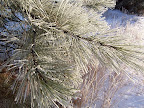


AB
AB
Saturday, January 05, 2008
Here are the books I read last year that were worth reading, in no particular order:
The Year of Magical Thinking, Didion
Great Expectations, Dickens
What Remains, Radziwill
Leaving the Saints, Beck
Beowulf, Heaney trans.
The Seven-Storey Mountain, Merton
Harry Potter and the Deathly Hallows, Rowling
Extremely Loud and Incredibly Close, Foer
Three Cups of Tea, Mortensen
Wintersmith, Pratchett (young adult)
Jane Eyre, Bronte
Thirteenth Tale, Setterfield
An even dozen. Not bad.
The Year of Magical Thinking, Didion
Great Expectations, Dickens
What Remains, Radziwill
Leaving the Saints, Beck
Beowulf, Heaney trans.
The Seven-Storey Mountain, Merton
Harry Potter and the Deathly Hallows, Rowling
Extremely Loud and Incredibly Close, Foer
Three Cups of Tea, Mortensen
Wintersmith, Pratchett (young adult)
Jane Eyre, Bronte
Thirteenth Tale, Setterfield
An even dozen. Not bad.
Friday, December 21, 2007
evidence of schizophrenia
Here is a conversation:
Me: It is stupid to keep a blog. Who wants to know my silly opinions?
Other Me: Yeah, but you enjoy it. You compose posts in your head all the time.
Me: Yeah, but nobody reads them.
Other Me: well, that doesn't mean you can't write them anyway. And besides, some people read it, and they tell you they like it.
Me: But I don't even know what I'm doing. I use this voice that sounds like I know what I'm talking about, but the reality is that I'm not sure about anything.
Other Me: I don't think you're fooling anybody. I think it's obvious you don't know what you're talking about.
And on and on. And this is why there's not many posts recently. Because the "Me" voice is usually stronger than the "other me" voice.
Me: It is stupid to keep a blog. Who wants to know my silly opinions?
Other Me: Yeah, but you enjoy it. You compose posts in your head all the time.
Me: Yeah, but nobody reads them.
Other Me: well, that doesn't mean you can't write them anyway. And besides, some people read it, and they tell you they like it.
Me: But I don't even know what I'm doing. I use this voice that sounds like I know what I'm talking about, but the reality is that I'm not sure about anything.
Other Me: I don't think you're fooling anybody. I think it's obvious you don't know what you're talking about.
And on and on. And this is why there's not many posts recently. Because the "Me" voice is usually stronger than the "other me" voice.
Thursday, December 06, 2007
But on the other hand, I've had fairly profound experiences that meant a great deal to me during the past month with each of my "areas" (Christian, Buddhism, agnosticism). I just don't see how I could give any of them up. I'm reading a book by Brian McLaren (Finding Faith)(the old, single volume version) that has really helped me. McLaren is the pastor of a Bible church in Maryland. I don't always agree with his conclusions, but his line of thinking has been like a balm for my wounded Christian spirit. I don't think I'll ever end up being an orthodox Christian again -- meaning one that believes in the Virgin birth, the bodily resurrection, the existence of a literal heaven and hell and specific people who go there, etc-- but I believe in the message of Christianity. Not the evangelical message, I've already talked about my disagreements with that. But the message of love for one's neighbor, and one's neighbor is everyone you encounter. The message of the power of love to heal the wounds of living in this messed-up world, no matter what the nature of those wounds. The message of the Sermon on the Mount-- true power doesn't come from financial, military, or authoritarian power; true power comes from loving and serving and giving.
I'm also listening to Pema Chodron's Noble Heart, a ten-day retreat on cultivating bodichitta, the practice of an awakened heart. I'm not comfortable acting as a spokesperson for Buddhism, but it's effect on me has been profound. Even while typing what I believed about Christianity, I found myself thinking in Buddhist terms. "the wounds of living in Samsara." True compassion for one's neighbor begins with true compassion for one's self, "unlimited friendliness" toward our own failings and limitations, Pema calls it. This morning I was listening to the bit about how our minds have an innate capacity for being open and spacious, not tied up with the soap opera of our lives, if we can just shut up long enough to let our minds do their spacious thing. (she didn't phrase it like that, of course). This isn't new to me-- it's the kind of thing you read all the time in buddhist writing. But if you've been raised as an over-achieving Westerner, it's not intuitively obvious, and sometimes it's hard to believe. All those busy, busy thoughts seem so important. I've been trying meditation for some time now. I could easily concentrate here on how terrible-- no, how truly awful -- I am at meditation (maybe I'll do another post on that sometime), but what's relevant for the moment is that just this morning I caught a glimmer of that spaciousness. It's there, if we can just let go of the drama long enough to let it be.
And then there's agnosticism. To be honest, this is the one that feels the most real to me right now. I'm having a hard time believing in anything at the moment. I have a long track record of this. To doubt is fundamental to who I am, or at least, to who I perceive myself to be (Buddhism again). I love to question, to rip things apart. I'm not always great at putting them back together again. I'm reading God is not Great, which is atheist and not agnostic, of course. But I'm not done yet, so more on that later.
But I'm re-thinking my fractions. (you know, the one-third this, one-third that, one-third the other bit.) Because I'm not an agnostic in the sense Huxley intended. At least I don't think so. I think a true agnostic believes that since we can't know the answer to most of our questions about God and eternal truths, we can't believe. But I do believe. I don't know precisely how to name what it is that I believe in, but I do know that there is something there. Make that capital-S Something. There is Something beyond the ordinary sensory experience of life. I've said this so many times before I'm feeling redundant but it has been awhile, so here it is again. I don't know what it is that I connect with-- if it's something within my own consciousness or subconsciousness, if it's God or the Divine Source or cosmic strings or neurons firing in my cerebral cortex or what. But there is definitely Something that I connect with, and I believe in it. I have faith in it, even though my faith falters at times. And further: I believe it is worth connecting with. I think that last bit is the thing that atheists miss.
I'm so glad I'm not worrying about dangling prepositions anymore. That paragraph is full of them.
So I'm changing my fractions. One-third Christian, one-third Buddhist, and one-third something else, and I'm not sure what to call it. I've been thinking about this for awhile, but haven't typed it out because I don't know how to put it into words. But it has something to do with what we do with the stuff of our life, our experience; what we create out of the day-to-day details of living. I'm tempted to call it art. I believe in what we create out of ourselves and our experience, whether it is a literal work of art or a family or a home or a business. Or is it that I believe in the process of creating something out of ourselves? I was reminded of this today-- and here, far too many words later, I finally get to what prompted me to write this today.
My daughter's high school is a half dozen blocks from our church. Every year in December, the high school choir, which is excellent, walks down to our church at lunchtime and puts on a brief Christmas concert. I was there for it today and it was lovely. I've known a dozen or so of these kids for years-- one since she was in kindergarten with my daughter, many others since they were gangly, awkward 13 or 14 year olds. And some of them are still pretty goofy. Lovable, but goofy. But you put all of them together and their love for each other and their affection for their director and their respect and care for the music comes together and creates something far more than the sum of its parts, something that can move me nearly to tears. The concert wasn't perfect; they were trying out some new songs and there were a few rough edges. But it was something else, something better than clinical perfection, something that I aspire to myself. Let me know if you think of how to describe this, a word for it. Life is what you make it, yes? But I mean that in a much deeper way than the flip, casual way in which that phrase is usually said.
Oh, have I ever gone on too long this time. My apologies for the length. And reading over this, I realize that I've used the word "something" way too often and with many different meanings, but I don't know how to re-word it at the moment, so that's all for today.
Aunt BeaN
I'm also listening to Pema Chodron's Noble Heart, a ten-day retreat on cultivating bodichitta, the practice of an awakened heart. I'm not comfortable acting as a spokesperson for Buddhism, but it's effect on me has been profound. Even while typing what I believed about Christianity, I found myself thinking in Buddhist terms. "the wounds of living in Samsara." True compassion for one's neighbor begins with true compassion for one's self, "unlimited friendliness" toward our own failings and limitations, Pema calls it. This morning I was listening to the bit about how our minds have an innate capacity for being open and spacious, not tied up with the soap opera of our lives, if we can just shut up long enough to let our minds do their spacious thing. (she didn't phrase it like that, of course). This isn't new to me-- it's the kind of thing you read all the time in buddhist writing. But if you've been raised as an over-achieving Westerner, it's not intuitively obvious, and sometimes it's hard to believe. All those busy, busy thoughts seem so important. I've been trying meditation for some time now. I could easily concentrate here on how terrible-- no, how truly awful -- I am at meditation (maybe I'll do another post on that sometime), but what's relevant for the moment is that just this morning I caught a glimmer of that spaciousness. It's there, if we can just let go of the drama long enough to let it be.
And then there's agnosticism. To be honest, this is the one that feels the most real to me right now. I'm having a hard time believing in anything at the moment. I have a long track record of this. To doubt is fundamental to who I am, or at least, to who I perceive myself to be (Buddhism again). I love to question, to rip things apart. I'm not always great at putting them back together again. I'm reading God is not Great, which is atheist and not agnostic, of course. But I'm not done yet, so more on that later.
But I'm re-thinking my fractions. (you know, the one-third this, one-third that, one-third the other bit.) Because I'm not an agnostic in the sense Huxley intended. At least I don't think so. I think a true agnostic believes that since we can't know the answer to most of our questions about God and eternal truths, we can't believe. But I do believe. I don't know precisely how to name what it is that I believe in, but I do know that there is something there. Make that capital-S Something. There is Something beyond the ordinary sensory experience of life. I've said this so many times before I'm feeling redundant but it has been awhile, so here it is again. I don't know what it is that I connect with-- if it's something within my own consciousness or subconsciousness, if it's God or the Divine Source or cosmic strings or neurons firing in my cerebral cortex or what. But there is definitely Something that I connect with, and I believe in it. I have faith in it, even though my faith falters at times. And further: I believe it is worth connecting with. I think that last bit is the thing that atheists miss.
I'm so glad I'm not worrying about dangling prepositions anymore. That paragraph is full of them.
So I'm changing my fractions. One-third Christian, one-third Buddhist, and one-third something else, and I'm not sure what to call it. I've been thinking about this for awhile, but haven't typed it out because I don't know how to put it into words. But it has something to do with what we do with the stuff of our life, our experience; what we create out of the day-to-day details of living. I'm tempted to call it art. I believe in what we create out of ourselves and our experience, whether it is a literal work of art or a family or a home or a business. Or is it that I believe in the process of creating something out of ourselves? I was reminded of this today-- and here, far too many words later, I finally get to what prompted me to write this today.
My daughter's high school is a half dozen blocks from our church. Every year in December, the high school choir, which is excellent, walks down to our church at lunchtime and puts on a brief Christmas concert. I was there for it today and it was lovely. I've known a dozen or so of these kids for years-- one since she was in kindergarten with my daughter, many others since they were gangly, awkward 13 or 14 year olds. And some of them are still pretty goofy. Lovable, but goofy. But you put all of them together and their love for each other and their affection for their director and their respect and care for the music comes together and creates something far more than the sum of its parts, something that can move me nearly to tears. The concert wasn't perfect; they were trying out some new songs and there were a few rough edges. But it was something else, something better than clinical perfection, something that I aspire to myself. Let me know if you think of how to describe this, a word for it. Life is what you make it, yes? But I mean that in a much deeper way than the flip, casual way in which that phrase is usually said.
Oh, have I ever gone on too long this time. My apologies for the length. And reading over this, I realize that I've used the word "something" way too often and with many different meanings, but I don't know how to re-word it at the moment, so that's all for today.
Aunt BeaN
Wednesday, December 05, 2007
I've said before that I'm a Buddhist agnostic Christian. Or an Agnostic Christian Buddhist. Or a Christian Buddhist agnostic. You get the idea. It depends on the day you ask which one of those is the noun and which are the qualifiers. This isn't always popular. You get the impression from some people that it is wrong to combine ideas. If you're Christian, you're somehow betraying The Church if you adopt ideas from Buddhists or atheists. Or if you're atheist, you're lower than dirt if you admit that sometimes you have spiritual feelings that make you wonder. You don't get that from everyone, of course. Lots of people out there have cobbled together their own belief system. But I get it from enough people, from all three of my "areas," that it bugs me sometimes.
And I have to admit that the idea of adopting a single belief system and declaring complete loyalty to it is pretty appealing to me. Probably partly because I was raised to believe that is the "right" way to do it, but also because I know some people who are that way whose faith I envy. In the past week I've spent time with two dear friends, one Mormon and one Buddhist, who are both radiant with the happiness that their belief system brings them. They have each found the system that suits them, clearly. It's obvious from the way they glow when they talk about it. I'm fairly comfortable with my weird, one-person path most of the time, but I don't glow. I was envious.
AB
And I have to admit that the idea of adopting a single belief system and declaring complete loyalty to it is pretty appealing to me. Probably partly because I was raised to believe that is the "right" way to do it, but also because I know some people who are that way whose faith I envy. In the past week I've spent time with two dear friends, one Mormon and one Buddhist, who are both radiant with the happiness that their belief system brings them. They have each found the system that suits them, clearly. It's obvious from the way they glow when they talk about it. I'm fairly comfortable with my weird, one-person path most of the time, but I don't glow. I was envious.
AB
Sunday, December 02, 2007
I made it to 40,400-odd words. Better than last year, but still not 50,000. Maybe next year. Third time's the charm, right? The main consequence (for me) of participating in NaNoWriMo has been the most utter, profound respect for anyone who has written a real, full-length book. You are all gods, every one of you.
Subscribe to:
Posts (Atom)