I'm tired. I'm tired and frazzled, and I can't even feel sorry for myself, because I'm here and healthy, not even a headache today, not lying in a hospital bed recovering from a brain biopsy with two IVs and pneumatic compression wraps around my calves. The wraps are supposed to prevent blood clots. Every couple of minutes they make a puffing noise. AC says they remind her of Mrs. Puff on Spongebob. Sometimes she is brave and full of gallows humor. Sometimes not.
We set up a group on Facebook to help them out, and within 48 hours we had more than 30 people signed up. We're taking turns fixing food for them and helping out however they need it. I'm on for dinner tonight, and there is barbecue beef in the crockpot, a salad in the fridge, and I just took a pan of brownies out of the oven. Originally I was going to take it over to their house, but after some further conversation, they're coming here, along with another family in our neighborhood. The kids are tired of being home without their parents (their grandmother is here), and they (the kids) are stressed and confused, but since none of us know what is going to happen at this point, we're all confused. It's difficult. AC was supposed to come home today, but she hasn't responded well to the anti-seizure meds (which I think are standard after this kind of surgery), so they're keeping her another day.
At least it's hard to get too stressed about school, because who the hell cares? Which is unfortunate, because I have a 3-5 page prospectus due on Tuesday, plus a test in my linguistics class. I was a volunteer judge at our local high school speech and debate meet today (there are dozens of volunteer judges, no experience necessary). Usually I love doing it, but today I couldn't concentrate. They were so bright and enthusiastic. I don't see how people can moan and groan about how awful young people are today. Only if they haven't spent any time with any of them.
Oh, and we have snow. About three inches, with more in the forecast. Which isn't necessarily a bad thing-- I don't mind snow as long as it doesn't keep me from being able to drive. And as long as it's not March. :-)
So.... that was all over the place, wasn't it? But it's all I've got the energy for today. Please keep praying for AC.
Saturday, November 19, 2011

Friday, November 18, 2011
putting things in perspective
my friend AC had her biopsy this morning. The surgery lasted a couple of hours, and it went well. The results won't be back at least until tomorrow and maybe not for a few days. it just seems so silly to be going on about my usual business, writing flaky blog posts, making plans for spring break, talking to Nell who is coming home for Thanksgiving next week. But what else can you do?
crash course part 2: what's wrong with romance novels?
These are the posts that make me cringe. What the hell am I doing? I'm no expert on this stuff. I've had three semesters of theory. But I get these ideas and they knock around in my head, and they want to come out. Y'all put up with a lot.
Anyway. You already know I read romance novels. This is the other side of the story from my previous post, and if you're going to be an intelligent reader of romance novels, you should think about this. (and just where did that soapbox come from?)
Simply stated, recent literary theory has been about examining our cultural assumptions, which is why it has come to be called cultural theory, or cultural studies. We generally take for granted that certain words carry a loose definition that we all get: male, female, straight, gay, white, Hispanic, African American. Women are nurturing and like to gossip; gays love Barbra Streisand and interior decorating; African Americans are good at dancing and sports. But first of all, there are exceptions to all of these. You don't have to work in an office environment very long to find out that men like to gossip just as much as women do (which may or may not be very much at all). There are straight men who are good at choosing paint colors. There are black people who can't dance.
You all know that. If it were that simple, there would be no problem with this. Of course everyone knows that there are exceptions to every rule. But unfortunately, not only do we have these loosely held definitions, we attach them to other religious or moral or traditional beliefs that make them take on a life of their own. The idea that women were maternal creatures who were better suited to life as homemakers took on a revered, almost holy status in the 1950s. It wasn't just that there was a tendency to think that most women wanted to be wives and mothers, but the idea took on a life of its own, so that advertising, magazines, movies, TV shows, and any number of other venues promulgated this idea of women as saintly madonnas, creating a haven in the home for their husbands and children. There was no escaping it. You could do your own thing, and doubtless many women did act in ways that were counter to the stereotype, but those were seen as deviant, unnatural behaviors. Sometimes harmless, but not natural. Abnormal. A generation of women downed valium to fit in.
It's not hard to see how that applies to ideas about race and sexual orientation. We all know that Asian Americans are good at math. Homophobia is so much a part of our current cultural mindset that we think it's creepy for a 4-year-old boy to wear pink overalls. And even if you're aware of how silly it is, you still don't feel like you can put your son in pink overalls, because then he, the little 4-year-old, would have to deal with the reactions he'd get from the people around him. Which would probably be subtle and not overt, but 4-year-olds are excellent at picking up on subtle cues. My point being that these cultural ideas take on religious significance, even when clearly there is nothing there but a cultural prejudice.
So how does this apply to romance novels? Well, with the exception of some of the best ones, romance novels for the most part reinforce all these cultural stereotypes that we would be better off without, and that many of us actively try to undermine in our non-reading moments. If there are gay characters, they are the loyal sidekicks. There are almost never non-white characters. The main character is almost never a servant or a member of the lower class. All of those reinforce the idea that the straight, white, middle-to-upper class point of view is the "real" point of view.
Other ideas enforced as "normal" by the entire genre of romance fiction, although they may be rare occurrences in real life:
-that a man and a woman can find completion and even transcendence in each other.
- In historical novels, servants are always loyal and happy to be of service to the people in the big house. If the steward is not happily loyal, then he ends up being the villain. The idea that servants might be good, honest people and also resent like hell the foibles of their employers practically never shows up in a historical romance.
-that a man should "take care" of a woman, which involves everything from the ubiquitous "Just lie back and let me take care of you" during intimacy to him being financially solvent--I think I've read two romances in the past two years where the man wasn't at the least in better economic circumstances than the woman, and usually he is flat out wealthy. (There is a way in which this "taking care" is true, of course, as long as it is mutual, and in the better romance novels, it is.)
-men that are taller, handsomer, and more physically fit are more valuable than short, dumpy, unathletic men. I can think of one hero that is even about the same height as the heroine (Summer to Remember), let alone shorter than her.
-there are no gradations of sexual orientation in the main characters, even though studies have shown that there are few human beings who are entirely gay or straight.
I'm not going to argue that you shouldn't read romance novels. You know that, if you've been following along. They're great escapism and fun entertainment, and even the most dedicated romance novel reader knows that they are just fantasies. No one (I hope) expects their real-life partner to never have any emotional needs of their own, which is what you'd think if all you knew were romance heroes. For me, part of the appeal of reading a romance novel is being able to let down my guard of trying to be vigilant and looking for all the ways that our culture is a bitch. They're a vacation from reality.
I don't even necessarily think that romance novelists should try to become crusaders for cultural change. (Historical novelists can often pull this off, because their 18th century characters can act like people from the 21st century and thus seem to be feminist or whatever.) that's part of the tradition and appeal of the genre.
I just think we should be aware of the implications of what we're reading.
There is so much more that could be said on this topic, and maybe some of you will help me out by saying intelligent things. And also pointing out romance novels that are exceptions to my generalizations. There's one more point to make here--about happy endings--but I think it's getting its own post. Probably not till next week, though.
Anyway. You already know I read romance novels. This is the other side of the story from my previous post, and if you're going to be an intelligent reader of romance novels, you should think about this. (and just where did that soapbox come from?)
Simply stated, recent literary theory has been about examining our cultural assumptions, which is why it has come to be called cultural theory, or cultural studies. We generally take for granted that certain words carry a loose definition that we all get: male, female, straight, gay, white, Hispanic, African American. Women are nurturing and like to gossip; gays love Barbra Streisand and interior decorating; African Americans are good at dancing and sports. But first of all, there are exceptions to all of these. You don't have to work in an office environment very long to find out that men like to gossip just as much as women do (which may or may not be very much at all). There are straight men who are good at choosing paint colors. There are black people who can't dance.
You all know that. If it were that simple, there would be no problem with this. Of course everyone knows that there are exceptions to every rule. But unfortunately, not only do we have these loosely held definitions, we attach them to other religious or moral or traditional beliefs that make them take on a life of their own. The idea that women were maternal creatures who were better suited to life as homemakers took on a revered, almost holy status in the 1950s. It wasn't just that there was a tendency to think that most women wanted to be wives and mothers, but the idea took on a life of its own, so that advertising, magazines, movies, TV shows, and any number of other venues promulgated this idea of women as saintly madonnas, creating a haven in the home for their husbands and children. There was no escaping it. You could do your own thing, and doubtless many women did act in ways that were counter to the stereotype, but those were seen as deviant, unnatural behaviors. Sometimes harmless, but not natural. Abnormal. A generation of women downed valium to fit in.
It's not hard to see how that applies to ideas about race and sexual orientation. We all know that Asian Americans are good at math. Homophobia is so much a part of our current cultural mindset that we think it's creepy for a 4-year-old boy to wear pink overalls. And even if you're aware of how silly it is, you still don't feel like you can put your son in pink overalls, because then he, the little 4-year-old, would have to deal with the reactions he'd get from the people around him. Which would probably be subtle and not overt, but 4-year-olds are excellent at picking up on subtle cues. My point being that these cultural ideas take on religious significance, even when clearly there is nothing there but a cultural prejudice.
So how does this apply to romance novels? Well, with the exception of some of the best ones, romance novels for the most part reinforce all these cultural stereotypes that we would be better off without, and that many of us actively try to undermine in our non-reading moments. If there are gay characters, they are the loyal sidekicks. There are almost never non-white characters. The main character is almost never a servant or a member of the lower class. All of those reinforce the idea that the straight, white, middle-to-upper class point of view is the "real" point of view.
Other ideas enforced as "normal" by the entire genre of romance fiction, although they may be rare occurrences in real life:
-that a man and a woman can find completion and even transcendence in each other.
- In historical novels, servants are always loyal and happy to be of service to the people in the big house. If the steward is not happily loyal, then he ends up being the villain. The idea that servants might be good, honest people and also resent like hell the foibles of their employers practically never shows up in a historical romance.
-that a man should "take care" of a woman, which involves everything from the ubiquitous "Just lie back and let me take care of you" during intimacy to him being financially solvent--I think I've read two romances in the past two years where the man wasn't at the least in better economic circumstances than the woman, and usually he is flat out wealthy. (There is a way in which this "taking care" is true, of course, as long as it is mutual, and in the better romance novels, it is.)
-men that are taller, handsomer, and more physically fit are more valuable than short, dumpy, unathletic men. I can think of one hero that is even about the same height as the heroine (Summer to Remember), let alone shorter than her.
-there are no gradations of sexual orientation in the main characters, even though studies have shown that there are few human beings who are entirely gay or straight.
I'm not going to argue that you shouldn't read romance novels. You know that, if you've been following along. They're great escapism and fun entertainment, and even the most dedicated romance novel reader knows that they are just fantasies. No one (I hope) expects their real-life partner to never have any emotional needs of their own, which is what you'd think if all you knew were romance heroes. For me, part of the appeal of reading a romance novel is being able to let down my guard of trying to be vigilant and looking for all the ways that our culture is a bitch. They're a vacation from reality.
I don't even necessarily think that romance novelists should try to become crusaders for cultural change. (Historical novelists can often pull this off, because their 18th century characters can act like people from the 21st century and thus seem to be feminist or whatever.) that's part of the tradition and appeal of the genre.
I just think we should be aware of the implications of what we're reading.
There is so much more that could be said on this topic, and maybe some of you will help me out by saying intelligent things. And also pointing out romance novels that are exceptions to my generalizations. There's one more point to make here--about happy endings--but I think it's getting its own post. Probably not till next week, though.
Wednesday, November 16, 2011
crash course in literary theory
And if that title didn't turn you off, I'm not sure what would. I'll try to make this interesting-- it's going somewhere in a future post. I'm going to start off with feminism at length, and then use that as a way to briefly discuss some of the other theories.
So when last we discussed feminism, which was last January, I believe (aside: I just went and looked and the post I was thinking about was November 2010. My, how the time it does fly.).... whoa. Anyway. Last time, I was talking about the difference between the "constructivist" way of looking at gender vs. the "essentialist," which is at the heart of gender theory. A constructivist believes that there is nothing inherently feminine or masculine, the idea of gender is "constructed" by our culture. The character traits we associate with being male or female are all just types of behavior that our culture has come to associate with that gender. There is nothing "essential" about gender, nothing built-in to every female that is feminine, or into every male that is masculine. An essentialist believes the opposite-- that there are ways of being that are "essentially" or (worse) "naturally" male or female.
In an academic environment, there is only one way to be: constructivist. In fact, in one of my theory books, the guy says that he always thinks that people who are essentialist don't really know what they are saying, because they couldn't possibly be essentialist if they understood what it means. Which immediately gets my back up-- who is he to define what somebody else believes? He's only defining what he thinks an essentialist believes. You don't get to define what your opponents believe.
He goes on to say that the essentialist point of view means that there is only one healthy, normal way of being male or female. Of course there are very few people that would agree with that statement, even among the most ultra-conservative. My own view was that there are poles of masculinity and femininity and that each of us fits somewhere on the continuum between the two; we each have our own unique combination of masculine and feminine traits. I felt pretty strongly about this, because I also believe strongly that our patriarchal culture neglects the feminine side of things in favor of the masculine. When feminists say that gender is constructed and that no one is inherently male or female, it seems to me that it's generally because they want those more powerful, more highly paid masculine attributes. So that feminists of that type become the ultimate betrayers of their own sisters.
but you see what I've done there: I've separated masculine and feminine qualities from the biological state of being male or female. It doesn't matter what your biological combination of Xs and Ys is, you can have any mix of masculine and feminine traits. sigh. In defending essentialism, I've become a constructivist. So I finally had to give in. They're right. I hate it that they're right, because "they" are often smug and strident and anti-"feminine." But on that particular issue, they're right. The intelligent hermaphroditic sea-horses of Alpha Centauri IV do not have the same conception of gender as we do. (get it? "conception" and sea-horses? it was a totally brilliant pun. really it was.) There is no inherent female-ness in the characteristics we think of as feminine.
My Modern Poetry professor tossed me a bone, though, after I explained my dilemma to him. He told me about "strategic essentialism," which is an idea of Gayatri Spivak's. There are times, apparently, when it is strategic to be essentialist. I haven't had time to read it yet, but I'm intrigued. I hope she means exactly what I've said above-- in defense of the feminine side of things, it is sometimes necessary to take an essentialist stance.
I'm barely started. If this bores you, tune out for the next several days. just sayin'.
So when last we discussed feminism, which was last January, I believe (aside: I just went and looked and the post I was thinking about was November 2010. My, how the time it does fly.).... whoa. Anyway. Last time, I was talking about the difference between the "constructivist" way of looking at gender vs. the "essentialist," which is at the heart of gender theory. A constructivist believes that there is nothing inherently feminine or masculine, the idea of gender is "constructed" by our culture. The character traits we associate with being male or female are all just types of behavior that our culture has come to associate with that gender. There is nothing "essential" about gender, nothing built-in to every female that is feminine, or into every male that is masculine. An essentialist believes the opposite-- that there are ways of being that are "essentially" or (worse) "naturally" male or female.
In an academic environment, there is only one way to be: constructivist. In fact, in one of my theory books, the guy says that he always thinks that people who are essentialist don't really know what they are saying, because they couldn't possibly be essentialist if they understood what it means. Which immediately gets my back up-- who is he to define what somebody else believes? He's only defining what he thinks an essentialist believes. You don't get to define what your opponents believe.
He goes on to say that the essentialist point of view means that there is only one healthy, normal way of being male or female. Of course there are very few people that would agree with that statement, even among the most ultra-conservative. My own view was that there are poles of masculinity and femininity and that each of us fits somewhere on the continuum between the two; we each have our own unique combination of masculine and feminine traits. I felt pretty strongly about this, because I also believe strongly that our patriarchal culture neglects the feminine side of things in favor of the masculine. When feminists say that gender is constructed and that no one is inherently male or female, it seems to me that it's generally because they want those more powerful, more highly paid masculine attributes. So that feminists of that type become the ultimate betrayers of their own sisters.
but you see what I've done there: I've separated masculine and feminine qualities from the biological state of being male or female. It doesn't matter what your biological combination of Xs and Ys is, you can have any mix of masculine and feminine traits. sigh. In defending essentialism, I've become a constructivist. So I finally had to give in. They're right. I hate it that they're right, because "they" are often smug and strident and anti-"feminine." But on that particular issue, they're right. The intelligent hermaphroditic sea-horses of Alpha Centauri IV do not have the same conception of gender as we do. (get it? "conception" and sea-horses? it was a totally brilliant pun. really it was.) There is no inherent female-ness in the characteristics we think of as feminine.
My Modern Poetry professor tossed me a bone, though, after I explained my dilemma to him. He told me about "strategic essentialism," which is an idea of Gayatri Spivak's. There are times, apparently, when it is strategic to be essentialist. I haven't had time to read it yet, but I'm intrigued. I hope she means exactly what I've said above-- in defense of the feminine side of things, it is sometimes necessary to take an essentialist stance.
I'm barely started. If this bores you, tune out for the next several days. just sayin'.
a nice moment
I had planned a long post today, but I have no time, so it will have to wait. But I haven't missed a day with this NaBloPoMo thing yet, so I need something. I thought I would tell you a quick story.
So if you've been around, you know my dad passed away last June, and that my relationship with him was difficult. I've spent a fair amount of time over the past few months processing anger and confusion and resentment and and and. If you've been reading along, I've probably bored the crap out of you with it.
But a couple of nights ago I was making myself a V-8 to drink while I was fixing dinner. My dad used to fix them. It's sort of like a Virgin Mary, I guess, but we would never have called it that at our house, it was just something to drink. You pour as much V-8 as you want in a glass, then shake in some worcestershire, and tabasco, and squeeze in some lemon or lime juice. It seems like there was something to shake into it, too-- probably Lawry's Seasoning Salt, or maybe Lemon Pepper (I skipped that this time). I was standing there in the kitchen making it and simultaneously being my 7-year-old self, with my dad carefully showing me how to do it.
And I realized that the good memories, the stuff that he did so well and taught so well, are always with me. The bad stuff I need to process and work through, but the good stuff is so much a part of me that most of the time I'm not even aware of his influence. And there are a lot of things like that: he taught me how to change the oil in my car (which I never do, but I know how!), and how to watch a football game (a down is like a chance, they get four chances to move the ball ten yards...). He took a baseball once and showed us how to change your grip to throw a curveball or a slider (not that I ever did that, either, but I understand the idea anyway). He helped my sisters and I pick out cars any time we were buying a new one.
So, yeah. The good bits are always with me.
So if you've been around, you know my dad passed away last June, and that my relationship with him was difficult. I've spent a fair amount of time over the past few months processing anger and confusion and resentment and and and. If you've been reading along, I've probably bored the crap out of you with it.
But a couple of nights ago I was making myself a V-8 to drink while I was fixing dinner. My dad used to fix them. It's sort of like a Virgin Mary, I guess, but we would never have called it that at our house, it was just something to drink. You pour as much V-8 as you want in a glass, then shake in some worcestershire, and tabasco, and squeeze in some lemon or lime juice. It seems like there was something to shake into it, too-- probably Lawry's Seasoning Salt, or maybe Lemon Pepper (I skipped that this time). I was standing there in the kitchen making it and simultaneously being my 7-year-old self, with my dad carefully showing me how to do it.
And I realized that the good memories, the stuff that he did so well and taught so well, are always with me. The bad stuff I need to process and work through, but the good stuff is so much a part of me that most of the time I'm not even aware of his influence. And there are a lot of things like that: he taught me how to change the oil in my car (which I never do, but I know how!), and how to watch a football game (a down is like a chance, they get four chances to move the ball ten yards...). He took a baseball once and showed us how to change your grip to throw a curveball or a slider (not that I ever did that, either, but I understand the idea anyway). He helped my sisters and I pick out cars any time we were buying a new one.
So, yeah. The good bits are always with me.
Tuesday, November 15, 2011
there are no words
A dear friend of mine found out about ten days ago that she has a brain tumor. On Friday, she found out that it is probably inoperable. The whole thing just sucks. She and her husband have two kids, one of whom has had his own horrendous set of health issues. If you pray, or otherwise extend healing hopes, please say a prayer for my friend AC. They're doing a biopsy on Friday.
Monday, November 14, 2011
public denouements
The thing that started this whole train of thought is a discussion on ArghInk last week about public denouements in romance novels and movies, which reminded me of a couple of things I've had in my head as possible blog posts. and since I'm doing this 30-day thing and I've got nothing else, here we go on the third day in a row about romance novels. Apologies to those of you that don't read them, I know I have a few of you. But at least I'm letting you know in the first paragraph so you can skip!
As I've said plenty of times before, I'm an introvert, and pretty shy to boot, so the idea of a public declaration of love is like a nightmare to me. It's taking something that should be private, an intimate moment between two people, and making it into a spectacle. From my perspective, it feels like cheapening the moment-- going for the laugh, the rim shot, over an honest connection between two people. It occasionally works when the entire plot has been about the couple's involvement with family and friends (While You were Sleeping), but that is rare, in my opinion.
but the discussion on ArghInk really made me think. Statistically speaking, introverts are in the minority in our culture. I haven't seen the numbers in years, but when I took the Meyers-Briggs test a long time ago, it was a fairly marked difference-- something like 70-30 extraverts/introverts. So most people don't feel that way. The commenters on that discussion made completely reasonable arguments that a public declaration is a way of ...hmmm, I'm having a hard time summarizing an argument I can't feel. anyway, the idea was something along the lines of expressing your commitment as part of your involvement in a community. That a private ending leaves you hanging, because where can it go? how will they act in the community if there's been no public expression of their commitment? it becomes self-involved and insignificant.
Which is why it's good to read other people's opinions. I get that, and can understand a little bit now why people feel that way. It made me think that maybe the way to do it (if I were writing a romance novel) is a private declaration of love, followed by some kind of public acknowledgement-- a wedding, of course, being the classic. And, as one commenter pointed out, it works differently for different people. A shy heroine wouldn't want a public scene, but for some character types, the public scene works perfectly.
It helps me understand why so many authors go for the big, comic, public ending, which I hate, but most other people seem to love. The example used was the scene at the end of Heaven, Texas. The hero, a gorgeous celebrity football player who has to fend off women all the time, has used his "Football Quiz" for years as a way to weed out women he isn't serious about. At the end of the book, half the town shows up at the side of the road where the hero has chased down the heroine as she is fleeing town (and him), and there is a big raucous scene as he gives her the quiz, proposes, etc. I hated it. The whole idea of the football quiz was insulting and sexist, and the big public scene just felt humiliating and embarrassing to me. I would never have been able to forgive the guy for that.
But reading everybody else's take on it, I found that I could finally understand why some people love that scene. Some people don't mind being the center of attention in a crowd; there are even people who crave it. For someone who is truly extroverted, a private declaration of love would be pointless, because why would it count if it's just the two of you and no witnesses? It's like it didn't happen. In the Heaven example, the quiz functioned as a way for the hero to say publicly that he was no longer judging women by the same standards. And the public humiliation-- if you're truly extroverted, maybe any kind of attention is better than no attention at all. I don't mind making a fool out of myself if it entertains people??? I don't know, I'm just trying to imagine how this feels.
another thing the ArghInk discussion shot down is my thought that this obsession with public denouements (because they seem to be at the end of every contemporary these days) is that it has to do with the Facebook generation. My daughter and her friends used to have a saying that if it isn't on Facebook, it didn't happen. (Now that all their moms are on Facebook, they have probably moved on to something else.) I thought maybe "these kids" are so used to their lives being public fodder that they no longer see the point in anything being private. But the discussion on ArghInk spanned generations, so that theory is out.
And.... you are thinking, and quite reasonably so.... why, if I am so introverted, to I post all this stuff in a publicly accessible blog? and it's an excellent question. But there are certain fairly huge parts of my life that I never, ever post about. And I don't promote my blog, other than having the link in my name when I comment elsewhere. I get discouraged when my pageviews drop really low, but generally speaking, having about 10-20 regular readers is perfect for me. That's as many as I want. I tried having AB3 on a public RSS feed about a year ago, and hated it. It felt like I was out there for the world to see, since the feed was on a blog that probably had at least dozens and maybe hundreds of readers a day.
Ha. when I sat down, this was going to end with a book review, but it's too long now and I don't have any more time. I guess maybe this will run over into yet another day.
As I've said plenty of times before, I'm an introvert, and pretty shy to boot, so the idea of a public declaration of love is like a nightmare to me. It's taking something that should be private, an intimate moment between two people, and making it into a spectacle. From my perspective, it feels like cheapening the moment-- going for the laugh, the rim shot, over an honest connection between two people. It occasionally works when the entire plot has been about the couple's involvement with family and friends (While You were Sleeping), but that is rare, in my opinion.
but the discussion on ArghInk really made me think. Statistically speaking, introverts are in the minority in our culture. I haven't seen the numbers in years, but when I took the Meyers-Briggs test a long time ago, it was a fairly marked difference-- something like 70-30 extraverts/introverts. So most people don't feel that way. The commenters on that discussion made completely reasonable arguments that a public declaration is a way of ...hmmm, I'm having a hard time summarizing an argument I can't feel. anyway, the idea was something along the lines of expressing your commitment as part of your involvement in a community. That a private ending leaves you hanging, because where can it go? how will they act in the community if there's been no public expression of their commitment? it becomes self-involved and insignificant.
Which is why it's good to read other people's opinions. I get that, and can understand a little bit now why people feel that way. It made me think that maybe the way to do it (if I were writing a romance novel) is a private declaration of love, followed by some kind of public acknowledgement-- a wedding, of course, being the classic. And, as one commenter pointed out, it works differently for different people. A shy heroine wouldn't want a public scene, but for some character types, the public scene works perfectly.
It helps me understand why so many authors go for the big, comic, public ending, which I hate, but most other people seem to love. The example used was the scene at the end of Heaven, Texas. The hero, a gorgeous celebrity football player who has to fend off women all the time, has used his "Football Quiz" for years as a way to weed out women he isn't serious about. At the end of the book, half the town shows up at the side of the road where the hero has chased down the heroine as she is fleeing town (and him), and there is a big raucous scene as he gives her the quiz, proposes, etc. I hated it. The whole idea of the football quiz was insulting and sexist, and the big public scene just felt humiliating and embarrassing to me. I would never have been able to forgive the guy for that.
But reading everybody else's take on it, I found that I could finally understand why some people love that scene. Some people don't mind being the center of attention in a crowd; there are even people who crave it. For someone who is truly extroverted, a private declaration of love would be pointless, because why would it count if it's just the two of you and no witnesses? It's like it didn't happen. In the Heaven example, the quiz functioned as a way for the hero to say publicly that he was no longer judging women by the same standards. And the public humiliation-- if you're truly extroverted, maybe any kind of attention is better than no attention at all. I don't mind making a fool out of myself if it entertains people??? I don't know, I'm just trying to imagine how this feels.
another thing the ArghInk discussion shot down is my thought that this obsession with public denouements (because they seem to be at the end of every contemporary these days) is that it has to do with the Facebook generation. My daughter and her friends used to have a saying that if it isn't on Facebook, it didn't happen. (Now that all their moms are on Facebook, they have probably moved on to something else.) I thought maybe "these kids" are so used to their lives being public fodder that they no longer see the point in anything being private. But the discussion on ArghInk spanned generations, so that theory is out.
And.... you are thinking, and quite reasonably so.... why, if I am so introverted, to I post all this stuff in a publicly accessible blog? and it's an excellent question. But there are certain fairly huge parts of my life that I never, ever post about. And I don't promote my blog, other than having the link in my name when I comment elsewhere. I get discouraged when my pageviews drop really low, but generally speaking, having about 10-20 regular readers is perfect for me. That's as many as I want. I tried having AB3 on a public RSS feed about a year ago, and hated it. It felt like I was out there for the world to see, since the feed was on a blog that probably had at least dozens and maybe hundreds of readers a day.
Ha. when I sat down, this was going to end with a book review, but it's too long now and I don't have any more time. I guess maybe this will run over into yet another day.
Sunday, November 13, 2011
book reviews (again)
I've received two e-mails asking me what the name of the author was from yesterday's post, so I came up with An Idea. I'll explain and you can tell me if I'm dead wrong.
I didn't know book reviews were a touchy subject when I started blogging (I've talked about this before). It never occurred to me that the actual authors might read my reviews. Never even crossed my mind. Authors are godlike creatures living in an alternate plane where they wrestle with their muse and produce books that arrive in bookstores and libraries ready to be devoured, right? Why in the world would someone like that want to read some ya-hoo's half-baked opinions? why would they care? I have no credentials except that I sit here and type.
But then I discovered that many of my favorite authors do, in fact, have quite a strong presence on the web, and are often heavily involved with their fans. Which is great, terrific, and says wonderful things about them as people, but it makes me want to run from the room. If I were ever to meet one of my favorites in person, I would be completely and utterly tongue-tied. Hero worship. And it gets even worse when I make some lame brain comment on one of their blogs and they actually respond.
And then several of the (non-author) blogs I follow stated that they never review books, because they don't want to hurt anyone's feelings, or (perhaps more importantly) injure their own chances of getting a book published by offending someone who has influence in the publishing industry. That second part is not a problem for me, since my fiction is so bad that I'm in no danger of getting it published, regardless of friends or enemies in the business. But the first part has caused me considerable thought. These godlike authors can get their feelings hurt? new thought for me, although obviously of course they can.
At that point, though, I said I was going to keep doing book reviews since that's one of the main reasons I started blogging: to be able to write about the books I read. But I seem to be incapable of writing a 100% positive book review-- I've never read a perfect book, and why should I say a book is perfect when it's not? (See, this is that asperger's-ish thing. People's feelings are less important to me than other things, like being honest. This is not something to be proud of. Especially not when "being honest" means "stating my silly hyper-sensitive opinions about things that I'm really not qualified to comment on." But if you point out to me that I might have hurt someone's feelings, I am horrified.) And then it became apparent that an author might really have found one of my reviews (not a negative one, thank goodness). And then I read an interview with a pulitzer-prize winning author in which he said something to the effect of: a review can be 99% good, but the 1% negative is what you remember, not just the next day but years later.
So I gave up. You might have noticed that I haven't posted a book review in a long time. I have no desire whatsoever to be negative to someone who deserves only kudos for going through the insanity that is writing a book, and coming out with something that is good enough to be accepted for publication, and has been through the hands of agents, editors, and beta readers, all of whom are more competent, experienced readers than me. (than I? I just googled to check on that and got conflicting answers. It looks like technically it should be "than I.")
But here's the thing: I still have things to say about the books I read. And sometimes I really want to say them. So yesterday I wrote the "not a book review" post, thinking I would just say what I wanted to say and leave the identifying information out of it. And for the record, I don't worry about naming Nora Roberts. If a woman who has sold millions of books is worried about my penny-ass little opinion (which she can't possibly be), she deserves what she gets.
But this morning it occurred to me, what if I write the review, and then put the author and title in the comments? Because I don't think that web crawlers search the comments (web crawlers are the "things" that go through all the sites out there on the web and catalog "things" to appear in google searches--or yahoo or bing or whatever)("things" being the technical term). so what do you think?
Hmmm, this post was originally going to cover some other stuff, too, but it is long enough and I need to get back to reading James Joyce's biography. I'm not usually a biography fan, but I have to admit that this one is pretty interesting, especially if you've read some of his stuff. Turns out almost everything he wrote has its roots in real things from his life. ("things" again).
And let me know if you know anything about web crawlers and comments.
I didn't know book reviews were a touchy subject when I started blogging (I've talked about this before). It never occurred to me that the actual authors might read my reviews. Never even crossed my mind. Authors are godlike creatures living in an alternate plane where they wrestle with their muse and produce books that arrive in bookstores and libraries ready to be devoured, right? Why in the world would someone like that want to read some ya-hoo's half-baked opinions? why would they care? I have no credentials except that I sit here and type.
But then I discovered that many of my favorite authors do, in fact, have quite a strong presence on the web, and are often heavily involved with their fans. Which is great, terrific, and says wonderful things about them as people, but it makes me want to run from the room. If I were ever to meet one of my favorites in person, I would be completely and utterly tongue-tied. Hero worship. And it gets even worse when I make some lame brain comment on one of their blogs and they actually respond.
And then several of the (non-author) blogs I follow stated that they never review books, because they don't want to hurt anyone's feelings, or (perhaps more importantly) injure their own chances of getting a book published by offending someone who has influence in the publishing industry. That second part is not a problem for me, since my fiction is so bad that I'm in no danger of getting it published, regardless of friends or enemies in the business. But the first part has caused me considerable thought. These godlike authors can get their feelings hurt? new thought for me, although obviously of course they can.
At that point, though, I said I was going to keep doing book reviews since that's one of the main reasons I started blogging: to be able to write about the books I read. But I seem to be incapable of writing a 100% positive book review-- I've never read a perfect book, and why should I say a book is perfect when it's not? (See, this is that asperger's-ish thing. People's feelings are less important to me than other things, like being honest. This is not something to be proud of. Especially not when "being honest" means "stating my silly hyper-sensitive opinions about things that I'm really not qualified to comment on." But if you point out to me that I might have hurt someone's feelings, I am horrified.) And then it became apparent that an author might really have found one of my reviews (not a negative one, thank goodness). And then I read an interview with a pulitzer-prize winning author in which he said something to the effect of: a review can be 99% good, but the 1% negative is what you remember, not just the next day but years later.
So I gave up. You might have noticed that I haven't posted a book review in a long time. I have no desire whatsoever to be negative to someone who deserves only kudos for going through the insanity that is writing a book, and coming out with something that is good enough to be accepted for publication, and has been through the hands of agents, editors, and beta readers, all of whom are more competent, experienced readers than me. (than I? I just googled to check on that and got conflicting answers. It looks like technically it should be "than I.")
But here's the thing: I still have things to say about the books I read. And sometimes I really want to say them. So yesterday I wrote the "not a book review" post, thinking I would just say what I wanted to say and leave the identifying information out of it. And for the record, I don't worry about naming Nora Roberts. If a woman who has sold millions of books is worried about my penny-ass little opinion (which she can't possibly be), she deserves what she gets.
But this morning it occurred to me, what if I write the review, and then put the author and title in the comments? Because I don't think that web crawlers search the comments (web crawlers are the "things" that go through all the sites out there on the web and catalog "things" to appear in google searches--or yahoo or bing or whatever)("things" being the technical term). so what do you think?
Hmmm, this post was originally going to cover some other stuff, too, but it is long enough and I need to get back to reading James Joyce's biography. I'm not usually a biography fan, but I have to admit that this one is pretty interesting, especially if you've read some of his stuff. Turns out almost everything he wrote has its roots in real things from his life. ("things" again).
And let me know if you know anything about web crawlers and comments.
Saturday, November 12, 2011
not a book review
Nora Roberts is a publishing phenomenon like no other. You can love her or disdain her, but the woman knows how to write a book. When I first started reading romance novels a couple of years ago, I avoided her entirely because ...well.... Nora Roberts. She's not exactly someone to tell your Modern Poetry professor about. But I did finally read a few of her novels, and became fascinated. Once you accept her formula (if you can), she's a genius. I ended up reading at least a dozen of them, because I was trying to figure out what it is that she does and how she does it.
I still don't know, but damn, the woman almost never makes a mis-step. Like I said, you can love her or hate her, but she has her finger on the pulse of something that works for millions of readers. When a friend of mine was dealing with a husband with ALS whose health was rapidly deteriorating, I asked her what I could do to help. She asked me to send her a box of Nora Roberts. The escapism was exactly what she needed to get her through.
But I'm borrowing one of Roberts' rare mis-steps to prove a point. In one of her novels, one of the early trilogies, the hero and heroine have been dancing around each other, the hero ready to be more serious about their relationship, the heroine wanting to keep it casual. One night when they are with a group of friends and family, he announces peremptorily to the group that she is moving in with him as of that night--the first she's heard about it. She is infuriated.
They get in the car, you're expecting her to just blast him, but she doesn't say a word. She is completely silent until they are in his apartment. It makes absolutely no sense. Roberts explains it by saying she (the heroine) is too mad to speak, but there is absolutely no reason why this character, who has never had a problem speaking when she was angry before, would suddenly be struck dumb.
Then they get to his apartment, and she starts to rant as he undresses and gets in his enormous jacuzzi tub. He ends up pulling her in, while she is still entirely clothed. And then I got it-- Oh. she had them be silent in the car to set it up so she could have the jacuzzi scene. It was a complete cop-out, in my opinion. She wanted the jacuzzi scene, so she had the heroine act in a way that was out of character. If you're going to refuse to move in, why wait until you're already there in the apartment to state your opinion? It makes no sense whatsoever. I was so irritated at that heroine for being such a wimp, because of course then she gives in, without him ever having asked what she wanted, or otherwise having to work out what the next step of their relationship is. Of course, really the person I was angry with was Roberts, for having her heroine act like such a wuss, all so she could set up the steamy (*smirk*) jacuzzi scene.
Apparently this kind of thing doesn't bother most readers. I just finished a new book, by someone who used to be one of my favorite authors, that is filled with moments like this-- smaller and less blatant, but still, you have the feeling that you're just moving from plot point to plot point instead of there being any legitimiate character development.
And it's especially disappointing to me because this woman was one of my most favorite romance novelists. Her first trilogy is still one of my all-time favorite series, and the four that followed it were even better. But her most recent series has been all about the formula, all about setting up these steamy or heartwarming or suspenseful or whatever moments, without worrying about the fact that to get there, her characters act in ways that make no sense from scene to scene. What happened? Did she change agents, or editors, or publishing houses? Did she start listening too much to focus groups to find out what readers want? Is she writing to what sells instead of what makes sense? Whatever it is, I wish she'd stop, because I used to love her books.
but on the other hand, another author--whose work I enjoy and admire--said in her blog this week that this exact same novel is probably the best romance novel of 2011. So what do I know. But even if I'm in the minority, I still don't have to like it. I'm about to give up on her. There's one more to come in this series, and I'm sure I'll read it, just to fninsh out the series. But if it's not considerably better, I'm done.
I still don't know, but damn, the woman almost never makes a mis-step. Like I said, you can love her or hate her, but she has her finger on the pulse of something that works for millions of readers. When a friend of mine was dealing with a husband with ALS whose health was rapidly deteriorating, I asked her what I could do to help. She asked me to send her a box of Nora Roberts. The escapism was exactly what she needed to get her through.
But I'm borrowing one of Roberts' rare mis-steps to prove a point. In one of her novels, one of the early trilogies, the hero and heroine have been dancing around each other, the hero ready to be more serious about their relationship, the heroine wanting to keep it casual. One night when they are with a group of friends and family, he announces peremptorily to the group that she is moving in with him as of that night--the first she's heard about it. She is infuriated.
They get in the car, you're expecting her to just blast him, but she doesn't say a word. She is completely silent until they are in his apartment. It makes absolutely no sense. Roberts explains it by saying she (the heroine) is too mad to speak, but there is absolutely no reason why this character, who has never had a problem speaking when she was angry before, would suddenly be struck dumb.
Then they get to his apartment, and she starts to rant as he undresses and gets in his enormous jacuzzi tub. He ends up pulling her in, while she is still entirely clothed. And then I got it-- Oh. she had them be silent in the car to set it up so she could have the jacuzzi scene. It was a complete cop-out, in my opinion. She wanted the jacuzzi scene, so she had the heroine act in a way that was out of character. If you're going to refuse to move in, why wait until you're already there in the apartment to state your opinion? It makes no sense whatsoever. I was so irritated at that heroine for being such a wimp, because of course then she gives in, without him ever having asked what she wanted, or otherwise having to work out what the next step of their relationship is. Of course, really the person I was angry with was Roberts, for having her heroine act like such a wuss, all so she could set up the steamy (*smirk*) jacuzzi scene.
Apparently this kind of thing doesn't bother most readers. I just finished a new book, by someone who used to be one of my favorite authors, that is filled with moments like this-- smaller and less blatant, but still, you have the feeling that you're just moving from plot point to plot point instead of there being any legitimiate character development.
And it's especially disappointing to me because this woman was one of my most favorite romance novelists. Her first trilogy is still one of my all-time favorite series, and the four that followed it were even better. But her most recent series has been all about the formula, all about setting up these steamy or heartwarming or suspenseful or whatever moments, without worrying about the fact that to get there, her characters act in ways that make no sense from scene to scene. What happened? Did she change agents, or editors, or publishing houses? Did she start listening too much to focus groups to find out what readers want? Is she writing to what sells instead of what makes sense? Whatever it is, I wish she'd stop, because I used to love her books.
but on the other hand, another author--whose work I enjoy and admire--said in her blog this week that this exact same novel is probably the best romance novel of 2011. So what do I know. But even if I'm in the minority, I still don't have to like it. I'm about to give up on her. There's one more to come in this series, and I'm sure I'll read it, just to fninsh out the series. But if it's not considerably better, I'm done.
Friday, November 11, 2011
left behind #1
There are lots of great things about the house we're leaving, but there is nothing I will miss more than this:

Can you see what it is? It's our measuring wall. Permanently attached to the wall behind the laundry room door. The main recent thing it shows is MadMax passing me by last spring, and pulling about dead even with Nell as of today. *sniff*
I have a feeling there will be a series of these, so that's why this is #1.

Can you see what it is? It's our measuring wall. Permanently attached to the wall behind the laundry room door. The main recent thing it shows is MadMax passing me by last spring, and pulling about dead even with Nell as of today. *sniff*
I have a feeling there will be a series of these, so that's why this is #1.
Wednesday, November 09, 2011
Riffday: alligator lizards in the air
The title is unrelated to anything--I was listening to (what music? anyone care to ID? no fair googling) on my drive home today and that line stuck in my head. So I have nothing significant to say today, therefore I will just tell you some of the things I was thinking about while driving.
First of all, I have reached the point in the semester where the commute just feels ennnnnddddllllllesssssss. It feels like I'm driving and driving and driving. Thankfully it has been a beautiful fall, because the scenery is the only thing making it worthwhile at the moment.
So here is my rhetorical physics question for today. (I said that like I have rhetorical physics questions every day.) My commute takes place almost entirely on a state highway that runs more-or-less straight North-South. For most of it, I'm driving parallel to a mountain range-- not as spectacular as anything in Colorado, but pretty enough, especially now that the tops are dusted with snow, a nice contrast to the golden wheat fields and changing leaves that are closer to the road. The mountains are about 20 miles away from the road. There is one long straightaway where there are several ponds and marshes along the road, and the mountains are reflected in them perfectly. The water is right there next to the road, and the mountains are 20 miles away. How does that work? It just doesn't seem right. It seems like you should just see sky.
But however it works, it's spectacularly beautiful. It's like a mirror image of the mountains on the ground. Especially this afternoon, since I was driving that stretch right as the sun was going down and the water was practically glowing. And THEN, as if that wasn't enough, when I got to the part where the road follows the edge of a 27-mile long lake, the moon was up, casting a long path of light across the water. It was breathtaking.
Another section of my drive, maybe a couple of miles or so, is along the west edge of the National Bison Range. The NBR is over 18,000 acres, so in the four semesters I've been doing this commute, I've never seen bison out there, and I haven't really expected to. You have to drive into the middle of it to see the bison. But then a couple of weeks ago, there was a huge bull bison right there, about 250 yards from the road, just grazing in a field. And both days this week, a herd of about 30-40 bison were grazing in one of the coulees. I'm not sure what changed, but it's fun to see them.
So. I guess I can't complain too much about the drive after all.
I'm listening to Hyperion, a Dan Simmons science fiction novel that is (with its sequel, The Fall of Hyperion) one of my all-time favorite books. This is my 3rd time reading it, but my first time on audiobook. This first volume is all setup-- there are 7 travelers on a mission, and in the first book, you just hear all seven of their stories. They've used different people for the seven different voices, and although sometimes I don't care for that, it is pretty well done.
But I have to say I've been hanging out too much on writing websites. I was mentally critiquing the first 35 pages or so before I got sucked into the story. Tsk, tsk, he's telling and not showing. Too many -ly adverbs in that paragraph. The prologue isn't really necessary, is it? Or if it is, why is it called a "prologue"? why isn't it just chapter 1? I wondered if I was going to be able to get through it.
But once the first traveler started telling his story, I forgot about all that. So I think this will remain firmly on my all-time favorites list. I had forgotten how creepy it is at times. Perfect for this time of year.
First of all, I have reached the point in the semester where the commute just feels ennnnnddddllllllesssssss. It feels like I'm driving and driving and driving. Thankfully it has been a beautiful fall, because the scenery is the only thing making it worthwhile at the moment.
So here is my rhetorical physics question for today. (I said that like I have rhetorical physics questions every day.) My commute takes place almost entirely on a state highway that runs more-or-less straight North-South. For most of it, I'm driving parallel to a mountain range-- not as spectacular as anything in Colorado, but pretty enough, especially now that the tops are dusted with snow, a nice contrast to the golden wheat fields and changing leaves that are closer to the road. The mountains are about 20 miles away from the road. There is one long straightaway where there are several ponds and marshes along the road, and the mountains are reflected in them perfectly. The water is right there next to the road, and the mountains are 20 miles away. How does that work? It just doesn't seem right. It seems like you should just see sky.
But however it works, it's spectacularly beautiful. It's like a mirror image of the mountains on the ground. Especially this afternoon, since I was driving that stretch right as the sun was going down and the water was practically glowing. And THEN, as if that wasn't enough, when I got to the part where the road follows the edge of a 27-mile long lake, the moon was up, casting a long path of light across the water. It was breathtaking.
Another section of my drive, maybe a couple of miles or so, is along the west edge of the National Bison Range. The NBR is over 18,000 acres, so in the four semesters I've been doing this commute, I've never seen bison out there, and I haven't really expected to. You have to drive into the middle of it to see the bison. But then a couple of weeks ago, there was a huge bull bison right there, about 250 yards from the road, just grazing in a field. And both days this week, a herd of about 30-40 bison were grazing in one of the coulees. I'm not sure what changed, but it's fun to see them.
So. I guess I can't complain too much about the drive after all.
I'm listening to Hyperion, a Dan Simmons science fiction novel that is (with its sequel, The Fall of Hyperion) one of my all-time favorite books. This is my 3rd time reading it, but my first time on audiobook. This first volume is all setup-- there are 7 travelers on a mission, and in the first book, you just hear all seven of their stories. They've used different people for the seven different voices, and although sometimes I don't care for that, it is pretty well done.
But I have to say I've been hanging out too much on writing websites. I was mentally critiquing the first 35 pages or so before I got sucked into the story. Tsk, tsk, he's telling and not showing. Too many -ly adverbs in that paragraph. The prologue isn't really necessary, is it? Or if it is, why is it called a "prologue"? why isn't it just chapter 1? I wondered if I was going to be able to get through it.
But once the first traveler started telling his story, I forgot about all that. So I think this will remain firmly on my all-time favorites list. I had forgotten how creepy it is at times. Perfect for this time of year.
take that golden mean and stuff it
We all know the ways that our culture makes us feel bad because we don't measure up. We're not thin enough, rich enough, witty enough, beautiful enough-- oh, the list is just endless. We get it from magazines and TV shows and movies and even walking down the street. The frumpy among us don't attract attention; the young, beautiful, thin ones do.
But what I was thinking about on the treadmill this morning is the other end of our endless urge to fit in. The way we don't want to own our gifts, our brilliance, our unique amazingness. Because what then? Lift up the lid on that reluctance and what's there? I still won't fit in. I might stand out, I might attract attention. Other people might be jealous, or they might not like me anymore, or it might make someone feel bad because they don't have my kind of special-ness. It might throw off the dynamics of my friendships, my group. What happens to a writing group if one person has considerably more talent than the others? What happens to the dynamics in a group of co-workers if one woman is brilliant and beautiful and frighteningly good at what she does? or my own personal one: what if I'm spectacular this one time, and then people expect me to be that way all the time? and its variation: if I'm good at this, what if it leads to complicated social interactions that are way too complex for me?
And then there's the whole "stuck-up" thing, leftovers from the playground days. If I own my own brilliance, other people will think I'm stuck up, or a snob, or full of myself, or vain or conceited. Ah, the playground. The whole thing was about grinding you down, making your squiggly, unwieldy, capacious self fit in that little bitty mold of acceptability. And you go from the playground to junior high. How in the world did we survive?
Here's my treadmill thoughts for today. First of all, forget the playground bullshit. There's some kind of playground economy that makes us feel like there's a tiny supply of one kind of brilliance and everybody wants it. Only a few people can be the popular people while the rest of us look on longingly from the sidelines. Don't believe it. There's plenty of brilliance, oceans of it, infinite overflowing barrels of it in all shapes, colors, sizes, and types. You've got plenty, and there's still an infinite amount left for everybody else.
And secondly, you do have to watch out about becoming a snot about it. There's a fine line here, and it's complicated. How do I own my own brilliance, without becoming conceited and full of myself? (We're speaking hypothetically here, because I haven't owned mine yet.) I think it must take recognizing that although your amazing gifts are yours alone, you aren't the only one that has gifts. Everyone does, their own unique brand of them. Ironic as it may sound, I think you have to have a bit of humility about being brilliant-- they're my gifts, and yet in some way, I'm not responsible for them. Whether it comes easily or you have to work really hard, there's still some way that our gifts are exactly that: gifts. Something to be grateful for.
I think my fear about this part of it goes back to my post about confidence the other day. I don't want to be one of the kids on the playground that is good at stuff and makes some hypothetical other kids feel bad. In the past, I'd rather just be mediocre than make someone else feel bad. But I'm coming around on this one. It really is their problem if they want my kind of gifts and not their own; there's not much I can do about that.
One final thought: I think this reluctance to acknowledge our own gifts is different than fear of failure. Fear of failure is about going out and trying something new, something you might be good at or you might not. I'm talking about acknowledging who we already are. Allowing the things that I'm good at (which may be small, behind-the-scenes kinds of things) to be just as amazing as more showy ones. Allowing myself to feel good about who I am, because dang, I'm good at (*insert your gifts here*). Entertaining toddlers. Dumping stuff in a crockpot and having it turn out well. Spiking a volleyball. Listening patiently to my daughter describe a movie. Putting words together in sentences. Teaching basketball. Organizing a bunch of volunteers. Knowing which can of paint to buy to turn a ho-hum room into a warm, welcoming one. Macramé. It could be anything.
And (of course) I'm reluctant to post this, because what if people think I'm conceited? what if someone thinks that I think that I'm special? what if someone thinks that I think that they think that she thinks.... right back to junior high. Let's all just blow through that and be brilliant.
But what I was thinking about on the treadmill this morning is the other end of our endless urge to fit in. The way we don't want to own our gifts, our brilliance, our unique amazingness. Because what then? Lift up the lid on that reluctance and what's there? I still won't fit in. I might stand out, I might attract attention. Other people might be jealous, or they might not like me anymore, or it might make someone feel bad because they don't have my kind of special-ness. It might throw off the dynamics of my friendships, my group. What happens to a writing group if one person has considerably more talent than the others? What happens to the dynamics in a group of co-workers if one woman is brilliant and beautiful and frighteningly good at what she does? or my own personal one: what if I'm spectacular this one time, and then people expect me to be that way all the time? and its variation: if I'm good at this, what if it leads to complicated social interactions that are way too complex for me?
And then there's the whole "stuck-up" thing, leftovers from the playground days. If I own my own brilliance, other people will think I'm stuck up, or a snob, or full of myself, or vain or conceited. Ah, the playground. The whole thing was about grinding you down, making your squiggly, unwieldy, capacious self fit in that little bitty mold of acceptability. And you go from the playground to junior high. How in the world did we survive?
Here's my treadmill thoughts for today. First of all, forget the playground bullshit. There's some kind of playground economy that makes us feel like there's a tiny supply of one kind of brilliance and everybody wants it. Only a few people can be the popular people while the rest of us look on longingly from the sidelines. Don't believe it. There's plenty of brilliance, oceans of it, infinite overflowing barrels of it in all shapes, colors, sizes, and types. You've got plenty, and there's still an infinite amount left for everybody else.
And secondly, you do have to watch out about becoming a snot about it. There's a fine line here, and it's complicated. How do I own my own brilliance, without becoming conceited and full of myself? (We're speaking hypothetically here, because I haven't owned mine yet.) I think it must take recognizing that although your amazing gifts are yours alone, you aren't the only one that has gifts. Everyone does, their own unique brand of them. Ironic as it may sound, I think you have to have a bit of humility about being brilliant-- they're my gifts, and yet in some way, I'm not responsible for them. Whether it comes easily or you have to work really hard, there's still some way that our gifts are exactly that: gifts. Something to be grateful for.
I think my fear about this part of it goes back to my post about confidence the other day. I don't want to be one of the kids on the playground that is good at stuff and makes some hypothetical other kids feel bad. In the past, I'd rather just be mediocre than make someone else feel bad. But I'm coming around on this one. It really is their problem if they want my kind of gifts and not their own; there's not much I can do about that.
One final thought: I think this reluctance to acknowledge our own gifts is different than fear of failure. Fear of failure is about going out and trying something new, something you might be good at or you might not. I'm talking about acknowledging who we already are. Allowing the things that I'm good at (which may be small, behind-the-scenes kinds of things) to be just as amazing as more showy ones. Allowing myself to feel good about who I am, because dang, I'm good at (*insert your gifts here*). Entertaining toddlers. Dumping stuff in a crockpot and having it turn out well. Spiking a volleyball. Listening patiently to my daughter describe a movie. Putting words together in sentences. Teaching basketball. Organizing a bunch of volunteers. Knowing which can of paint to buy to turn a ho-hum room into a warm, welcoming one. Macramé. It could be anything.
And (of course) I'm reluctant to post this, because what if people think I'm conceited? what if someone thinks that I think that I'm special? what if someone thinks that I think that they think that she thinks.... right back to junior high. Let's all just blow through that and be brilliant.
Tuesday, November 08, 2011
the power nap
Yesterday's post started out with three paragraphs of how I couldn't think of anything to say, until suddenly I thought of garage sales. So I ended up deleting the first bit. So that means today I can whine about not being able to think of anything to say because I didn't say it yesterday, right? I could do a Poetry Tuesday, but we're still on Wallace Stevens and I just don't wanna. Not that there's nothing to say-- the more we read of him, the more I like him-- it's just that Poetry Tuesday takes work and I'm too tired. So tired I had to pull over at a scenic overlook on the drive home from UTown so I wouldn't fall asleep at the wheel. Took a five-minute catnap and then hit the road again.
Hmmm. Whine #1: Nothing to say. Whine #2: I'm tired. These things come in threes, right? so let's see.... another whine....
Except it just occurred to me I could write about naps. I love naps. Dean hates them. If he falls asleep in the afternoon, he crashes for two or three hours, and then feels like crap when he wakes up. When I take a nap, it takes me about ten minutes to fall asleep, then I sleep for about ten minutes, and then it takes about ten more minutes to wake up. Thirty minutes and I feel great.
Driving naps are even shorter. Sometimes I get so dopey that I'm afraid I'm going to crash. When that happens, if I pull into one of about a dozen scenic overlooks along my route, I can be asleep in under a minute. Five to ten minutes later, I wake up and am good to go. It's weird, I know. I worry a bit that someone's going to pull over to check on me sometime, and I will be embarrassed to death. But at least I won't have died in a car crash.
Hmmm, well, it's not Literary Art (and when are they?), but *check.* Another blog post for NaBloPoMo. :-) How do you feel about naps?
Hmmm. Whine #1: Nothing to say. Whine #2: I'm tired. These things come in threes, right? so let's see.... another whine....
Except it just occurred to me I could write about naps. I love naps. Dean hates them. If he falls asleep in the afternoon, he crashes for two or three hours, and then feels like crap when he wakes up. When I take a nap, it takes me about ten minutes to fall asleep, then I sleep for about ten minutes, and then it takes about ten more minutes to wake up. Thirty minutes and I feel great.
Driving naps are even shorter. Sometimes I get so dopey that I'm afraid I'm going to crash. When that happens, if I pull into one of about a dozen scenic overlooks along my route, I can be asleep in under a minute. Five to ten minutes later, I wake up and am good to go. It's weird, I know. I worry a bit that someone's going to pull over to check on me sometime, and I will be embarrassed to death. But at least I won't have died in a car crash.
Hmmm, well, it's not Literary Art (and when are they?), but *check.* Another blog post for NaBloPoMo. :-) How do you feel about naps?
Monday, November 07, 2011
Garage Sale woes
I enjoy poking around at other people's garage sales, and used to do it often when we needed stuff for the house. But for the past several years now, our house has been stuffed to the gills and we don't need any more stuff, so I haven't made the garage sale rounds in a long time.
But I've never liked having garage sales. I don't like the tedium of pricing everything. I don't like having to stand there while people paw through your things and make disparaging remarks, and I don't like that they bring $100 worth of stuff up to the counter and say, "Would you take $5 for this stuff?" I think you have to enjoy bargaining for this to be fun, and I don't. I don't like bargaining for cars, I don't like shopping in places where you're supposed to haggle over prices.
Wow, I sound really grumpy again, don't I?
But we have had them on occasion. When we'd been married for a couple of years, we had a garage sale with some friends where we sold off some of the many multiples of wedding gifts that we received (five picnic baskets, four brass planters, etc). We made over $200, and given that we were in graduate school and it was almost 30 years ago, that was a lot of money. But we had another one that wasn't really worth the trouble a few years after that, and then another similar one a few years after that, and so we quit doing them.
But then Nell got old enough to want to make some money off selling her old toys, so she talked us into another one-- this was probably five or six years ago. and I had some things to get rid of, so we agreed. We spent days collecting stuff, and pricing stuff and getting it all together, and then the day of the sale it poured. Not just a light shower, but huge, enormous, buckets of drenching rain all morning long. We had some furniture, so a couple of furniture dealers still came, but only about three other people showed up. The furniture dealers did their typical thing of offering you practically nothing. So all that work, and I think we made less than $100. And we still had all the stuff left that we had to get rid of anyway.
Never again, we said. Just take it to the Salvo and take the tax deduction. And that's what we've done ever since. Sometimes I think we keep that place in business.
But now we're going to have to get rid of tons of stuff-- not just the back of my car filled up, but several pickup loads of stuff. So I'm wavering. Nell is coming home for Thanksgiving (if she can get a ride), and I'm hoping she will be enthusiastic about it and want to help, especially if I offer to split the proceeds with her. Of course, given our track record, that might end up being $17.
Book Giveaway update: After several delays due mainly to the fact that I hate going to the post office, I mailed the book giveaway boxes today, except Anna's, because I still don't have your address. E-mail me, Anna!
And that's it for today.
But I've never liked having garage sales. I don't like the tedium of pricing everything. I don't like having to stand there while people paw through your things and make disparaging remarks, and I don't like that they bring $100 worth of stuff up to the counter and say, "Would you take $5 for this stuff?" I think you have to enjoy bargaining for this to be fun, and I don't. I don't like bargaining for cars, I don't like shopping in places where you're supposed to haggle over prices.
Wow, I sound really grumpy again, don't I?
But we have had them on occasion. When we'd been married for a couple of years, we had a garage sale with some friends where we sold off some of the many multiples of wedding gifts that we received (five picnic baskets, four brass planters, etc). We made over $200, and given that we were in graduate school and it was almost 30 years ago, that was a lot of money. But we had another one that wasn't really worth the trouble a few years after that, and then another similar one a few years after that, and so we quit doing them.
But then Nell got old enough to want to make some money off selling her old toys, so she talked us into another one-- this was probably five or six years ago. and I had some things to get rid of, so we agreed. We spent days collecting stuff, and pricing stuff and getting it all together, and then the day of the sale it poured. Not just a light shower, but huge, enormous, buckets of drenching rain all morning long. We had some furniture, so a couple of furniture dealers still came, but only about three other people showed up. The furniture dealers did their typical thing of offering you practically nothing. So all that work, and I think we made less than $100. And we still had all the stuff left that we had to get rid of anyway.
Never again, we said. Just take it to the Salvo and take the tax deduction. And that's what we've done ever since. Sometimes I think we keep that place in business.
But now we're going to have to get rid of tons of stuff-- not just the back of my car filled up, but several pickup loads of stuff. So I'm wavering. Nell is coming home for Thanksgiving (if she can get a ride), and I'm hoping she will be enthusiastic about it and want to help, especially if I offer to split the proceeds with her. Of course, given our track record, that might end up being $17.
Book Giveaway update: After several delays due mainly to the fact that I hate going to the post office, I mailed the book giveaway boxes today, except Anna's, because I still don't have your address. E-mail me, Anna!
And that's it for today.
Sunday, November 06, 2011
Dendrological insight, or aboriculture lesson, or silvics in action
Here's what I learned today: there are three words for the study of trees: arboriculture, dendrology, or silvics. They probably all mean slightly different things, but that's close enough for my purposes. Because I'm passing on what I learned 20 years ago when we visited here for the first time: not all trees that look like evergreens are actually .... um...... ever green. We have acres of Western Larch around us, which are "deciduous conifers," which means that every year in the fall they lose their needles. here are some pictures:

(note skiff of snow in the foreground. the western larch are the ones that are yellow.)

The needles turn yellow, and then:

they fall off.
But when there's an entire hillside of them mixed in with grand and douglas firs, they're pretty (it's kind of hazy here today, so this isn't the greatest picture, but you get the idea):
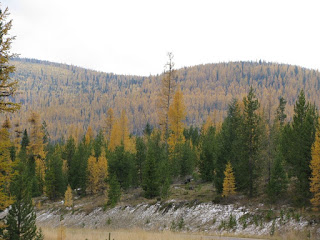
And that's all I've got. See you tomorrow.

(note skiff of snow in the foreground. the western larch are the ones that are yellow.)

The needles turn yellow, and then:

they fall off.
But when there's an entire hillside of them mixed in with grand and douglas firs, they're pretty (it's kind of hazy here today, so this isn't the greatest picture, but you get the idea):

And that's all I've got. See you tomorrow.
Saturday, November 05, 2011
the boob tube
I have nothing against television. At various times in my life, I have been utterly hooked on various TV shows-- usually the same ones everyone else is: Moonlighting, Northern Exposure, and what was that one that ended when the actor playing the lead accidentally shot himself in the head while goofing around on set? And Star Trek. Oh, my word, were (are) we Trekkers. The Original Series, which I started watching in grade school (it was a rerun damn it, I'm not that old). And then we were purists for the first two seasons of NextGen and refused to watch it, until Nell was born and I was going crazy pacing the floor with her during her colicky period and I actually tried it. Subtitles are an awesome thing when you are pacing the floor with a colicky infant. But for some reason, although we tried, we never got hooked on any of the other versions.
Anyway. At some point, though, television left me behind. Partly because of the age of my kids. When Nell was 10-14, there was nothing on television that was appropriate for her to watch. I wanted her to have her childhood, not be dealing with adult issues when she was 12. And then reality TV took over, and I completely lost interest. Other than a couple of episodes of HGTV shows that technically qualify as reality TV but aren't really like Survivor or American Idol, I don't think I've ever seen an entire episode of a reality TV show. I can never make it through. The people are dumb, or they are mean and conniving, or they're putting themselves through hell to get to a goal that doesn't mean anything to me. And anyway, it isn't reality, no matter how much they call it reality TV.
But then MadMax grew up enough to watch TV, and we were suddenly hooked on Dirty Jobs and Mythbusters and Deadliest Catch (which are technically reality TV, I know, but they're not contests where someone is getting kicked off the show every week, at least)(I'm too soft-hearted, I want everyone to win). And then we got a DVR-- less than a year ago-- and finally I am starting to enjoy TV again. You can fast forward through the commercials. You can get online, pick what shows you want to record with a click or two, and then watch them whenever you want.
So we still watch Mythbusters (how can you not love a show that tries to explode a garden shed by popping massive amounts of popcorn in it?), although not so much Dirty Jobs anymore because I think we've seen them all. We've added Family Guy (which still seems too adult to me for a 14-year-old, but when I object, he just rolls his eyes and says, "You think I don't know this, Mom?")(He gets jokes that would have gone over my head when I was in college.) And while Dean and MadMax were hunting in Idaho, they were introduced to Big Bang Theory. I have to admit I love it. It's so deliciously nerdy, and we are all nerds around here. We're branching out to Community, too.
And I've started watching Nigella. Have I ever posted about how much I love reading cookbooks? (a true irony, since I don't really cook all that well). So I've read 3-4 of her cookbooks. (If you've never read one, start with How to Eat, which I think was her first one, before she started her TV show.) They're hilarious, although I have to say I've only used a couple of her recipes-- they often have those furrin British ingredients that are hard to find around here.
But they were talking about her show on the Bettyverse awhile back and I realized I'd never seen it, as much as I adore her cookbooks. So I went to the DirecTV website, clicked to record it to our DVR, and finally got around to watching a couple of episodes this morning while I did my stretches. OMG, it is like watching foreplay. That woman loves her food, sensuously loves her food, and after awhile you start to wonder if she's having an affair with the camera-man. Her looks to the camera are alternately coy, come-hither, happy, sly, or all-out brilliantly happy. It's fun to watch. I might be hooked.
She's my kind of cook. A few inexact quotes: While chopping onions: "They could be chopped a bit more finely, but I'm stopping now." When having company over, "You want a bit of oomph. That's what this is about: oomph with ease." "I like xxx like this, but do as you please." ("do as you please" pronounced "Dooze you please" with a coy glance thrown over her shoulder.) Discussing sausages: "These are skinny sausages. I don't normally like that in anything." and the two shows I watched ended up with her, at night, slipping down to the fridge to nosh on the leftovers.
And did I mention how much I love fast-forwarding over the commercials? The last two commercial breaks were each FOUR MINUTES long. ACK.
good grief, this got long. It really wasn't going to be.
Anyway. At some point, though, television left me behind. Partly because of the age of my kids. When Nell was 10-14, there was nothing on television that was appropriate for her to watch. I wanted her to have her childhood, not be dealing with adult issues when she was 12. And then reality TV took over, and I completely lost interest. Other than a couple of episodes of HGTV shows that technically qualify as reality TV but aren't really like Survivor or American Idol, I don't think I've ever seen an entire episode of a reality TV show. I can never make it through. The people are dumb, or they are mean and conniving, or they're putting themselves through hell to get to a goal that doesn't mean anything to me. And anyway, it isn't reality, no matter how much they call it reality TV.
But then MadMax grew up enough to watch TV, and we were suddenly hooked on Dirty Jobs and Mythbusters and Deadliest Catch (which are technically reality TV, I know, but they're not contests where someone is getting kicked off the show every week, at least)(I'm too soft-hearted, I want everyone to win). And then we got a DVR-- less than a year ago-- and finally I am starting to enjoy TV again. You can fast forward through the commercials. You can get online, pick what shows you want to record with a click or two, and then watch them whenever you want.
So we still watch Mythbusters (how can you not love a show that tries to explode a garden shed by popping massive amounts of popcorn in it?), although not so much Dirty Jobs anymore because I think we've seen them all. We've added Family Guy (which still seems too adult to me for a 14-year-old, but when I object, he just rolls his eyes and says, "You think I don't know this, Mom?")(He gets jokes that would have gone over my head when I was in college.) And while Dean and MadMax were hunting in Idaho, they were introduced to Big Bang Theory. I have to admit I love it. It's so deliciously nerdy, and we are all nerds around here. We're branching out to Community, too.
And I've started watching Nigella. Have I ever posted about how much I love reading cookbooks? (a true irony, since I don't really cook all that well). So I've read 3-4 of her cookbooks. (If you've never read one, start with How to Eat, which I think was her first one, before she started her TV show.) They're hilarious, although I have to say I've only used a couple of her recipes-- they often have those furrin British ingredients that are hard to find around here.
But they were talking about her show on the Bettyverse awhile back and I realized I'd never seen it, as much as I adore her cookbooks. So I went to the DirecTV website, clicked to record it to our DVR, and finally got around to watching a couple of episodes this morning while I did my stretches. OMG, it is like watching foreplay. That woman loves her food, sensuously loves her food, and after awhile you start to wonder if she's having an affair with the camera-man. Her looks to the camera are alternately coy, come-hither, happy, sly, or all-out brilliantly happy. It's fun to watch. I might be hooked.
She's my kind of cook. A few inexact quotes: While chopping onions: "They could be chopped a bit more finely, but I'm stopping now." When having company over, "You want a bit of oomph. That's what this is about: oomph with ease." "I like xxx like this, but do as you please." ("do as you please" pronounced "Dooze you please" with a coy glance thrown over her shoulder.) Discussing sausages: "These are skinny sausages. I don't normally like that in anything." and the two shows I watched ended up with her, at night, slipping down to the fridge to nosh on the leftovers.
And did I mention how much I love fast-forwarding over the commercials? The last two commercial breaks were each FOUR MINUTES long. ACK.
good grief, this got long. It really wasn't going to be.
Friday, November 04, 2011
NaBloPoMo
Or something like that. Debbie is celebrating National Blog Post Month over at her place by posting every day for the month of November, and I'm tempted to do it here, too. (Julie does NaBloPoMo every month, she is already a Blog Goddess.) But my November is already looking beyond crazy. And I missed yesterday. Could I cheat and backdate one to yesterday? So anyway, I probably won't be able to keep it up, but I'm putting this here just in case I decide to get crazy and do it.
The phrase that popped into my head just then was "get a wild hair," which I had never heard before I moved here. As in, "Last weekend I got a wild hair and went dancing at the Blue Moon." The phrase always makes me smile, because I imagine out of my entire head of completely straight, thin, fine, boring hair, one single hair suddenly twisting up in a mad frenzy of curly insanity. I've heard it often, but never seen it in print. Then a couple of weeks ago, I saw it written somewhere and it was "get a wild hare." I was so bummed. Is that what it's about? rabbits? who knew? if it's a local phrase, none of you will be able to help me out (or at least, none of you that comment), but if you know the answer, please fill me in. Inquiring minds and all that.
And since this is mainly a placeholder post, I'll stop now, but leave you with this picture, which is of poor Jazz, trying to sleep in the cat's bed. I'm not sure what exactly prompted this-- probably sore hips, she's getting a bit arthritic. Some of you already saw it on Facebook, but I need something else here, so I'm posting it again.

(OK, I did the obvious and googled "get a wild hair" and looks like it can be either, but that it was originally "get a wild hair." And apparently in the south, it is "get a wild hair up your a--," but I never heard it in all my years of living in the South until we moved here. So now you know.)
The phrase that popped into my head just then was "get a wild hair," which I had never heard before I moved here. As in, "Last weekend I got a wild hair and went dancing at the Blue Moon." The phrase always makes me smile, because I imagine out of my entire head of completely straight, thin, fine, boring hair, one single hair suddenly twisting up in a mad frenzy of curly insanity. I've heard it often, but never seen it in print. Then a couple of weeks ago, I saw it written somewhere and it was "get a wild hare." I was so bummed. Is that what it's about? rabbits? who knew? if it's a local phrase, none of you will be able to help me out (or at least, none of you that comment), but if you know the answer, please fill me in. Inquiring minds and all that.
And since this is mainly a placeholder post, I'll stop now, but leave you with this picture, which is of poor Jazz, trying to sleep in the cat's bed. I'm not sure what exactly prompted this-- probably sore hips, she's getting a bit arthritic. Some of you already saw it on Facebook, but I need something else here, so I'm posting it again.

(OK, I did the obvious and googled "get a wild hair" and looks like it can be either, but that it was originally "get a wild hair." And apparently in the south, it is "get a wild hair up your a--," but I never heard it in all my years of living in the South until we moved here. So now you know.)
Thursday, November 03, 2011
the back post
OK, I thought of something quick I could fill in November 3rd with. Because Kim Kardashian filed for divorce this week after 72 days of marriage. Dean and I cynically gave them less than a year, but seventy-two days??? I've had migraines that lasted that long. and then she tried desperately to spin it so that she looked good and her poor husband looked bad. give up, Kim, because there's no way to spin that. If she'd said, "We rushed into this and we're separating while we get counseling," I might be skeptical, but I'd wish them well. "The public pressure is killing us, so we're going to an undisclosed location for six months to work it out," and I'd admire the hell out of her and hope the paparazzi would leave them alone. But file for divorce after 72 days? that's just lame. it doesn't even have enough strength of will behind it to qualify as bad, and certainly not evil. It's just stupid, silly, lameness. It must have been all about the wedding, the spectacle.
Wednesday, November 02, 2011
cheapness is as cheapness does
This is possibly not for male readers. Don't say I didn't warn you.
Today's topic is "Silly things I've done to save money."
Cheapness runs in my family. I get it from both sides. My dad's family was at times dirt poor. And even though my mom came from an upper middle class family, her mom was more of the Queen Elizabeth school of liberty prints and low-heeled shoes than any kind of chasing after fashion. Spending lots of money on clothes or hair or makeup or .... well, anything is frowned upon in my gene pool. My sisters and I still crow to each other over bargains found. Amy called me over the weekend to let me know that Sherwin Williams is having a big sale this week (because ohmygosh do we have lots of painting in our future).
So I sometimes go to questionable extremes to save money. Some examples:
- Drive half a mile to a gas station where gas is 3 cents per gallon cheaper. Total savings on my 20-gallon tank: sixty cents.
- I could write an entire post on cheap travel. We stayed in hostels in Europe this summer, and that was actually great-- a bit noisy, but clean and friendly and plenty of space. but this is about silly things, not smart things. things that may not quite be worth the effort. So here's a story: when I was 5 months pregnant with Nell, Dean and I went on our first-ever trip to NYC. This was in 1989, and we were not long out of graduate school. We had no money-- our idea of a big night out was to walk down the street and get ice cream. Hotel rooms in NYC, even the cheap ones, were upwards of $100/night. So I made reservations for us to stay at the YMCA. Not kidding. Don't do it. it was $78/night, which we still thought was expensive. It was....interesting. creaking metal bunk beds, crumbling cinder block walls.... I'd say it wasn't worth it, but we probably wouldn't have been able to go otherwise, so maybe it was.
- I'll lump a bunch of things under the category "the things I do to get the last little bit out of bottles of personal care products." I swipe wooden stir sticks from Starbucks to scoop the last bit out of small bottles with pump dispensers. Sometimes I can get an extra two weeks out of a bottle of moisturizer. I keep a pair of scissors by the shower to cut open my 12 oz tubes of conditioner. There's often 2-3 days worth of product left in the bottom that you can't squeeze out. I was thrilled one day at Home Depot to find that there are plastic syringes with long, skinny "noses" in the wallpaper supplies section. You can use them to refill travel size bottles of lotion. It takes half an hour, and probably saves about $1. But I do it. Obsessively. Often at 2 a.m. the night before we're going on a trip.
- This summer, I only had two pairs of capris and one pair of shorts that fit. So one night Dean and I were at Target, and I was wearing one of the pairs of capris, which are dark blue denim. He said, "There's something white on your butt," and I discovered that the "something white" was actually my panties showing through a small hole. I was ticked off. My favorite jeans capris. New clothes were not in the budget this summer after all our travels. And I don't sew. So I bought a pair of navy blue panties for $3.99. Problem solved. sort of.
I'm sure there are more. I'll think of them later. Feel free to chime in with your own examples!
Today's topic is "Silly things I've done to save money."
Cheapness runs in my family. I get it from both sides. My dad's family was at times dirt poor. And even though my mom came from an upper middle class family, her mom was more of the Queen Elizabeth school of liberty prints and low-heeled shoes than any kind of chasing after fashion. Spending lots of money on clothes or hair or makeup or .... well, anything is frowned upon in my gene pool. My sisters and I still crow to each other over bargains found. Amy called me over the weekend to let me know that Sherwin Williams is having a big sale this week (because ohmygosh do we have lots of painting in our future).
So I sometimes go to questionable extremes to save money. Some examples:
- Drive half a mile to a gas station where gas is 3 cents per gallon cheaper. Total savings on my 20-gallon tank: sixty cents.
- I could write an entire post on cheap travel. We stayed in hostels in Europe this summer, and that was actually great-- a bit noisy, but clean and friendly and plenty of space. but this is about silly things, not smart things. things that may not quite be worth the effort. So here's a story: when I was 5 months pregnant with Nell, Dean and I went on our first-ever trip to NYC. This was in 1989, and we were not long out of graduate school. We had no money-- our idea of a big night out was to walk down the street and get ice cream. Hotel rooms in NYC, even the cheap ones, were upwards of $100/night. So I made reservations for us to stay at the YMCA. Not kidding. Don't do it. it was $78/night, which we still thought was expensive. It was....interesting. creaking metal bunk beds, crumbling cinder block walls.... I'd say it wasn't worth it, but we probably wouldn't have been able to go otherwise, so maybe it was.
- I'll lump a bunch of things under the category "the things I do to get the last little bit out of bottles of personal care products." I swipe wooden stir sticks from Starbucks to scoop the last bit out of small bottles with pump dispensers. Sometimes I can get an extra two weeks out of a bottle of moisturizer. I keep a pair of scissors by the shower to cut open my 12 oz tubes of conditioner. There's often 2-3 days worth of product left in the bottom that you can't squeeze out. I was thrilled one day at Home Depot to find that there are plastic syringes with long, skinny "noses" in the wallpaper supplies section. You can use them to refill travel size bottles of lotion. It takes half an hour, and probably saves about $1. But I do it. Obsessively. Often at 2 a.m. the night before we're going on a trip.
- This summer, I only had two pairs of capris and one pair of shorts that fit. So one night Dean and I were at Target, and I was wearing one of the pairs of capris, which are dark blue denim. He said, "There's something white on your butt," and I discovered that the "something white" was actually my panties showing through a small hole. I was ticked off. My favorite jeans capris. New clothes were not in the budget this summer after all our travels. And I don't sew. So I bought a pair of navy blue panties for $3.99. Problem solved. sort of.
I'm sure there are more. I'll think of them later. Feel free to chime in with your own examples!
Tuesday, November 01, 2011
Poetry Tuesday: The Waste Land
Even though we finished The Waste Land about a month ago, I've avoided writing about it, because I don't really feel competent to tackle it. But we're still on Wallace Stevens in class, and the poems we've done the past two class meetings are not ones that would lend themselves to this format. ha. as if The Waste Land does.
But I'm backing up to it anyway. The Waste Land is more or less the defining moment in modernist poetry. (and by the way, in literary terms, the word "modern" or "modernist" doesn't mean now, it refers to (roughly) the first half of the twentieth century, up to the start of WWII). Eliot wrote it just after WWI. The fervid optimism and belief in progress and industrialization that characterized the end of the nineteenth century had come to a horrific end with WWI. In his personal life, Eliot was suffering through a miserable marriage. The world must truly have seemed a waste land.
The poem is difficult to a casual reader. For one thing, it's long-- about 20 pages in the mass market paperback we used. And it's thick with allusions, snippets of other works, references to mythology, and untranslated lines in German or Greek or Italian. Eliot was utterly unconcerned with whether or not John Doe sitting over his pint at the local pub could understand it. He wrote for other intellectuals, other thinkers, whom Eliot felt were the only ones who could comprehend what he wanted to say.
So why should we bother? If Eliot didn't care about the average reader, why should we care about him? It's a question most of the students in my class were asking. After not having read it in 25 years, I have to admit that the thought occurred to me as well. But like all good poetry, the more you read it, the more you find in it. It rewards study.
Anyway. One of the ways I entertain myself while doing my commute (10 hours a week, just to get back and forth to school), is to listen to podcasts. While I was reading The Waste Land, I listened to a panel discussion of four British academics talking about Eliot's great poem. At the end of the hour, after they'd gone on and on about the social conditions that inform it and the historical milieu and etc, the moderator asked, so why do people still read it? And the unanimous response was, "Because it has some great lines." (To which I, ever curious, wanted to reply, "Which ones?" because they didn't specify, dangit.)
So here are are my choices of great lines from The Waste Land. They're not necessarily pretty, but they're so perfectly apt, and often mordantly amusing.
The opening lines:
(If you hear Eliot read it--which you can, just google "Eliot reading the waste land," he makes "cru-ellest" into three syllables and sounds terribly snobbily British-- but he was born in St. Louis.)
(that last line is a quotation from Dante's Inferno. I don't know if Eliot meant to refer directly to WWI, but he might well have-- estimates of the death toll range from 9 million to far higher.)
and a few lines later:
Later, nameless woman begins to whine, presumably to her husband:
(like nails on a blackboard to all of us introverted types, yes?) The husband replies:
Hmmm. in context, those are some of the mordantly amusing lines, but maybe they don't come across that way pulled out like this.
Then perhaps the most famous line:
which is repeated five times scattered amongst lines in which a woman gossips cattily at a pub. It's the voice of the bartender, encouraging his customers to order their last drinks since the pub is closing. But as the line continues to be repeated (HURRY UP PLEASE ITS TIME), it takes on the sound of a bell tolling, or the Grim Reaper waiting. When I read this as an undergrad, this line crept into our repertoire of Things We Say. It's not uncommon even now for one of us to intone HURRY UP PLEASE ITS TIME when waiting for the kids or each other.
And his chilling description of a casual sexual encounter:
and the closing lines-- in the previous ones, I've skipped lines that have all the learned allusions, but here you go, so you can see what is like (parts of it, anyway):
The first line is Italian (from Dante again: "Then he hid himself in the fire that refines them"), the second is Latin ("when will I be like the swallow?"), and the third, French ("The prince of Aquitaine of the ruined tower"). Then the line starting "Why" is from an Elizabethan play by Thomas Kyd, and the closing lines are from Sanskrit: "Give. Sympathize. Control yourselves." "Shantih," according to Eliot, is the equivalent to an invocation of "the peace which passeth understanding."
Honestly, the lines of Eliot's that I remember most are from other poems. Like the opening lines of "The Love Song of Alfred J. Prufrock," because they're so unusual (and so famous)-- "Let us go then, you and I, / When the evening is spread out against the sky / Like a patient etherised upon a table...." And the beginning of "The Hollow Men," which I had to memorize in high school: "We are the hollow men / We are the stuffed men / Leaning together / Headpiece filled with straw."
There you have it. Eliot distilled down to a blog post. I didn't begin to do him justice.
But I'm backing up to it anyway. The Waste Land is more or less the defining moment in modernist poetry. (and by the way, in literary terms, the word "modern" or "modernist" doesn't mean now, it refers to (roughly) the first half of the twentieth century, up to the start of WWII). Eliot wrote it just after WWI. The fervid optimism and belief in progress and industrialization that characterized the end of the nineteenth century had come to a horrific end with WWI. In his personal life, Eliot was suffering through a miserable marriage. The world must truly have seemed a waste land.
The poem is difficult to a casual reader. For one thing, it's long-- about 20 pages in the mass market paperback we used. And it's thick with allusions, snippets of other works, references to mythology, and untranslated lines in German or Greek or Italian. Eliot was utterly unconcerned with whether or not John Doe sitting over his pint at the local pub could understand it. He wrote for other intellectuals, other thinkers, whom Eliot felt were the only ones who could comprehend what he wanted to say.
So why should we bother? If Eliot didn't care about the average reader, why should we care about him? It's a question most of the students in my class were asking. After not having read it in 25 years, I have to admit that the thought occurred to me as well. But like all good poetry, the more you read it, the more you find in it. It rewards study.
Anyway. One of the ways I entertain myself while doing my commute (10 hours a week, just to get back and forth to school), is to listen to podcasts. While I was reading The Waste Land, I listened to a panel discussion of four British academics talking about Eliot's great poem. At the end of the hour, after they'd gone on and on about the social conditions that inform it and the historical milieu and etc, the moderator asked, so why do people still read it? And the unanimous response was, "Because it has some great lines." (To which I, ever curious, wanted to reply, "Which ones?" because they didn't specify, dangit.)
So here are are my choices of great lines from The Waste Land. They're not necessarily pretty, but they're so perfectly apt, and often mordantly amusing.
The opening lines:
April is the cruellest month, breeding
Lilacs out of the dead land, mixing
Memory and desire, stirring
Dull roots with spring rain.(If you hear Eliot read it--which you can, just google "Eliot reading the waste land," he makes "cru-ellest" into three syllables and sounds terribly snobbily British-- but he was born in St. Louis.)
Unreal City,
Under the brown fog of a winter dawn,
A crowd flowed over London Bridge, so many,
I had not thought death had undone so many.
(that last line is a quotation from Dante's Inferno. I don't know if Eliot meant to refer directly to WWI, but he might well have-- estimates of the death toll range from 9 million to far higher.)
and a few lines later:
There I saw one I knew, and stopped him, crying: "Stetson!
"You who were with me in the ships at Mylae!
"That corpse you planted last year in your garden,
"Has it begun to sprout? Will it bloom this year?
"Or has the sudden frost disturbed its bed?
"Oh keep the Dog far hence, that's friend to men,
"Or with his nails he'll dig it up again!"
Later, nameless woman begins to whine, presumably to her husband:
"Speak to me. Why do you never speak. Speak.
"What are you thinking of? What thinking? What?
"I never know what you are thinking. Think."
(like nails on a blackboard to all of us introverted types, yes?) The husband replies:
I think we are in rats' alley
Where the dead men lost their bones.
Hmmm. in context, those are some of the mordantly amusing lines, but maybe they don't come across that way pulled out like this.
Then perhaps the most famous line:
HURRY UP PLEASE ITS TIME
which is repeated five times scattered amongst lines in which a woman gossips cattily at a pub. It's the voice of the bartender, encouraging his customers to order their last drinks since the pub is closing. But as the line continues to be repeated (HURRY UP PLEASE ITS TIME), it takes on the sound of a bell tolling, or the Grim Reaper waiting. When I read this as an undergrad, this line crept into our repertoire of Things We Say. It's not uncommon even now for one of us to intone HURRY UP PLEASE ITS TIME when waiting for the kids or each other.
And his chilling description of a casual sexual encounter:
The time is now propitious, as he guesses,
The meal is ended, she is bored and tired,
Endeavours to engage her in caresses
Which still are unreproved, if undesired.
Flushed and decided, he assaults at once;
Exploring hands encounter no defence;
His vanity requires no response,
and makes a welcome of indifference.
...
Bestows one final patronising kiss,
And gropes his way, finding the stairs unlit. . .
She turns and looks a moment in the glass,
Hardly aware of her departed lover;
Her brain allows one half-formed thought to pass:
"Well now that's done: and I'm glad it's over."
When lovely woman stoops to folly and
Paces about her room again, alone,
She smoothes her hair with automatic hand,
and puts a record on the gramophone.
and the closing lines-- in the previous ones, I've skipped lines that have all the learned allusions, but here you go, so you can see what is like (parts of it, anyway):
Poi s'ascose nel foco che gli affina
Quando fiam uti chelidon--O swallow swallow
Le Prince d'Aquitaine a la tour abolie
These fragments I have shored against my ruins
Why then Ile fit you. Hieronymo's mad againe.
Datta. Dayadhvam. Damyata.
Shantih shantih shantihThe first line is Italian (from Dante again: "Then he hid himself in the fire that refines them"), the second is Latin ("when will I be like the swallow?"), and the third, French ("The prince of Aquitaine of the ruined tower"). Then the line starting "Why" is from an Elizabethan play by Thomas Kyd, and the closing lines are from Sanskrit: "Give. Sympathize. Control yourselves." "Shantih," according to Eliot, is the equivalent to an invocation of "the peace which passeth understanding."
Honestly, the lines of Eliot's that I remember most are from other poems. Like the opening lines of "The Love Song of Alfred J. Prufrock," because they're so unusual (and so famous)-- "Let us go then, you and I, / When the evening is spread out against the sky / Like a patient etherised upon a table...." And the beginning of "The Hollow Men," which I had to memorize in high school: "We are the hollow men / We are the stuffed men / Leaning together / Headpiece filled with straw."
There you have it. Eliot distilled down to a blog post. I didn't begin to do him justice.
Subscribe to:
Posts (Atom)